
ガバナンスGovernance
Corporate Governance
Corporate Governance
Under our management principles, we will build a governance system that can effectively and efficiently achieve this. The Company's basic approach to Corporate Governance is to develop a management governance system and implement measures necessary for sound development while simultaneously ensuring management efficiency and legality, and we regard this as one of the most important management issues.
Corporate Governance Organizational Structure
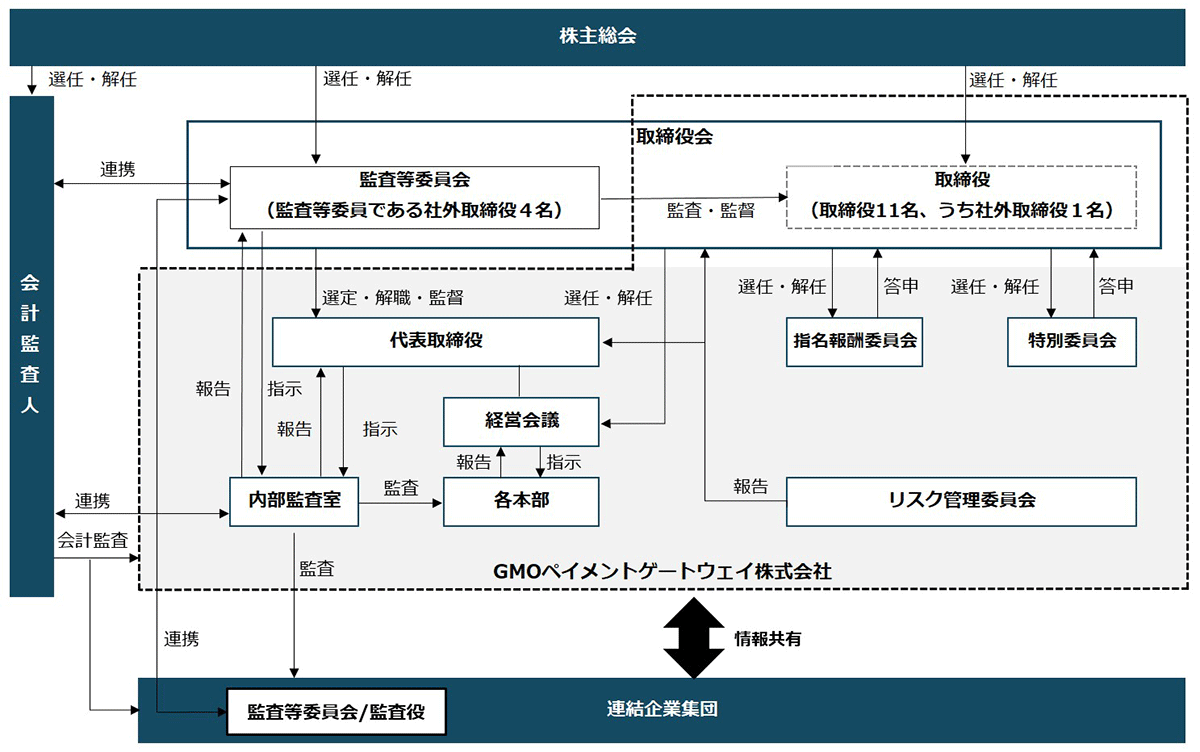
・Board of Directors
The Board of Directors consists of 13 directors (including 5 External Director), chaired by the representative director. The Board of Directors meets once a month and is held extraordinarily as necessary to make decisions on statutory matters and important matters for management, and supervises the execution of duties by directors to ensure transparency, efficiency, and fairness in decision-making. In addition, in order to clarify the management responsibilities of Directors and build a management system that can respond quickly to changes in the business environment, the term of office of Directors, except for those who are Audit and Supervisory Committee members, is set at one year. The term of office of directors who are Audit and Supervisory Committee members is two years.
・Audit and Supervisory Committee
The Audit and Supervisory Committee consists of four members who are External Director members of the Audit and Supervisory Committee. In accordance with the rules of the Audit and Supervisory Committee, the Audit and Supervisory Committee conducts audits by each Audit and Supervisory Committee member, attending important meetings as well as the Board of Directors, investigating the status of operations and assets, etc., and giving necessary instructions to Internal Audit Office and receiving reports.
・Management Committee
The Management Committee is an important decision-making body for business execution to strengthen the management supervisory function by separating supervision and execution, and is composed of some directors and executive officers, including the representative director, and meets at least once a month in principle. The Management Committee deliberates on important matters related to business execution based on the basic policy established by the Board of Directors, and is held to contribute to appropriate and prompt decision-making and efficient business execution.
・Nomination and Remuneration Committee
The Nomination and Remuneration Committee shall be composed of directors (excluding those who are members of the Audit and Supervisory Committee). The committee consists of five directors (of which three are External Director), and External Director is appointed as the chairperson. As an advisory body to the Board of Directors, the Board of Directors deliberates on the policy for the appointment of Directors, etc., each candidate, the remuneration system for officers, the amount of remuneration, the plan for the successor of the Representative Director, etc., from an objective and fair perspective, and reports to the Board of Directors, etc. as necessary.
・ Internal Audit Office
The Company has established a Internal Audit Office with three dedicated staff members who conduct audits of the Group's material risks and internal controls. Specifically, in accordance with the Internal Audit Regulations established by the Company, the Company conducts internal audits of internal departments and subsidiary to ensure that business is being conducted legally and appropriately in accordance with laws and regulations, the Articles of Incorporation, and internal rules, and reports the results to the Board of Directors and the Representative Director, as well as to the Audit and Supervisory Committee members.
・Risk Management Committee
In order to effectively and efficiently implement risk management for the entire Group, we have established a Risk Management Committee and are promoting initiatives throughout the Group.
・Special Committees
As an advisory body to the Board of Directors, the Special Committee is composed of five External Director members who are independent directors, and deliberates and examines important transactions and actions that conflict with the interests of the controlling shareholder and the minority shareholder in order to protect the interests of minority shareholders and strengthen the governance of the Board of Directors.
Continuous Improvement of Governance
・Policies and procedures for appointing directors
With regard to the selection of candidates for directors, the Company pays attention to ensuring that directors have the knowledge, experience, and abilities necessary to effectively fulfill their roles and responsibilities, and that the Board of Directors is composed in a manner that balances the diversity (nationality, gender, and age) and appropriate size of the Board of Directors. Candidates for directors are selected in accordance with this policy, and after deliberation by the Nomination and Remuneration Committee, they are submitted to the Board of Directors for decision.
・Independence Standards for Outside Officers
In designating External Director, including those who are members of the Audit and Supervisory Committee, as independent officers, in order to determine their independence, the Company designates persons who meet the "Detailed Regulations on Independence Standards for Outside Officers" independently established by the Company as independent officers.
・Evaluation of the effectiveness of the Board of Directors
Once a year, the Company analyzes and evaluates the effectiveness of the Board of Directors and strives to improve the functions of the Board of Directors.
Specifically, while incorporating objective and quantitative methods such as questionnaires to all directors, we evaluate the effectiveness of the Board of Directors and strive to ensure that its effectiveness is appropriately ensured not only in terms of the composition and operation of the Board of Directors, but also from a wide range of perspectives, such as institutional design and the nomination and remuneration of each director.
At the same time, with the aim of further strengthening functions, we continuously formulate and implement improvement measures for issues related to the Board of Directors that were identified during the evaluation process.
In the fiscal year ending September 2025, we conducted a questionnaire survey of 15 directors (of whom 5 were External Director) to compile and analyze the results of the responses.
As a result, the Company's Board of Directors evaluates that the current situation, Management Policy, and important business execution decisions, and reports on the status of business execution are made in a timely manner, and that appropriate supervision of business execution is being carried out, and that the effectiveness of the business execution is ensured. In the process of analysis and evaluation, issues such as "consideration of succession development plans for CEOs and others" and "provision of training opportunities for directors" were pointed out, and we will continue to make efforts to improve them.
・Remuneration of officers
In order to ensure the appropriateness of officer remuneration and the transparency of the decision-making process, the Nomination and Remuneration Committee has been established as an advisory body to the Board of Directors, with the chairman and a majority of the members as independent External Director. Directors (excluding those who are Audit and Supervisory Committee members) The remuneration (including bonuses, etc.) of directors is determined by the Board of Directors after deliberation by the Nomination and Remuneration Committee.
When determining the details of remuneration for each individual director, the Nomination and Remuneration Committee conducts a multifaceted examination, including consistency with the decision policy, and the Board of Directors basically respects its report. In addition, the remuneration of directors who are Audit and Supervisory Committee members consists only of fixed remuneration from the perspective of emphasizing independence and objectivity in management, and the amount of remuneration for each director who is an Audit and Supervisory Committee member is determined by consultation with the Audit and Supervisory Committee.
In addition, in order to further enhance our sustainability management, since the fiscal year ended September 2022, we have incorporated ESG indicators into some of the individual-specific performance-linked compensation of Director Executive Vice President in charge of sustainability. ESG indicators account for 3.5% of the total performance-linked compensation, and we have set the CDP Climate Change Score and FTSE Russell ESG Score as key KPIs. These indicators are evaluated based on the degree of improvement from the previous fiscal year, and the amount of compensation is increased or decreased according to the achievement status of each KPI.
The evaluation and remuneration decision are also decided after deliberation by the Nomination and Remuneration Committee.
・Policy on training for directors
Regarding the Company's policy of training for directors, it is a principle that each officer, who is a management professional, strives to acquire the necessary knowledge and improve their abilities in their own judgments, and deepens and shares knowledge and abilities through detailed discussions at the Board of Directors and through prior briefings for External Director.
In addition, we will use external seminars on the Companies Act, Corporate Governance, etc. at the request of each director, and external seminars and other seminars for new officers as appropriate to acquire the necessary knowledge as officers.
Director Skills Matrix
| identity | position | GMO-ism Practice *1 |
enterprise management |
IT & security |
risk management |
Legal | Finance, accounting |
payment processing company business |
finance | global | investment (M&A) |
ESG・ Sustainer Ability |
board of directors Attendance rate *2 |
Audit & Supervisory Committee Attendance rate *2 |
Nomination and Remuneration Committee Attendance rate *2 |
|---|---|---|---|---|---|---|---|---|---|---|---|---|---|---|---|
| Issei Ainoura | President & Chief Executive Officer | 〇 | 〇 | 94% | - | - | |||||||||
| Masatoshi Kumagai | Chairman of the Board | 〇 | 〇 | 100% | - | - | |||||||||
| Ryu Muramatsu | Director Executive Vice President | 〇 | 〇 | 〇 | 〇 | 〇 | 100% | - | - | ||||||
| Masashi Yasuda | director | 〇 | 〇 | 〇 | 100% | - | 100% | ||||||||
| Hirofumi Yamashita | director | 〇 | 〇 | 94% | - | - | |||||||||
| Noriko Inagaki | director | 〇 | 〇 | 〇 | 100% | - | - | ||||||||
| Yuki Kawasaki | director | 〇 | 〇 | 100% | - | - | |||||||||
| Takashi Shimahara | director | 〇 | 〇 | 〇 | 〇 | 100% | - | - | |||||||
| Fumio Kai | Director and Audit and Supervisory Committee Member | 〇 | 〇 | 〇 | 〇 | 88% | - | - | |||||||
| Masayuki Hijikuro | Director and Audit and Supervisory Committee Member | 〇 | 〇 | 〇 | 100% | 100% | - | ||||||||
| Osamu Ohkawa | Director and Audit and Supervisory Committee Member | 〇 | 〇 | 〇 | 100% | 100% | - | ||||||||
| Nishi no Division Guardian | Director and Audit and Supervisory Committee Member | 〇 | 〇 | 〇 | 〇 | - | - | - | |||||||
| Mizue Sato | Director and Audit and Supervisory Committee Member | 〇 | 〇 | - | - | - |
*1 GMOISM is a general term for the corporate motto and Our values of the GMO Internet Group, including the "Spirit Venture Declaration".
*2 Number of Board meetings held in the fiscal year ended September 2025: 17 Audit and Supervisory Committee meetings: 17 Nomination and Remuneration Committee meetings: 2
Selection of Accounting Auditor
The Audit and Supervisory Committee comprehensively evaluates and selects accounting auditors based on the "Practical Guidelines for Evaluation and Audit & Supervisory Board Member Selection Criteria for Accounting Auditors" published by the Japan Audit & Supervisory Board Member Association in accordance with the qualifications, expertise, independence from the Company, and other evaluation criteria as a selection policy for Auditor.
In addition, if the Accounting Auditor determines that the Accounting Auditor has fallen under the items specified in each item of Article 340, Paragraph 1 of the Companies Act, the Audit and Supervisory Committee shall decide on a proposal regarding the dismissal or non-appointment of the Accounting Auditor, and the Board of Directors shall submit the proposal to the Annual Meeting of Shareholders based on the decision.
The rotation of executive employees of the current accounting auditor is being implemented appropriately. The involvement of the chief executive employee is limited to five consecutive fiscal periods, and re-involvement is not permitted. In addition, the involvement of other executive employees is not permitted within the seven consecutive fiscal periods and until the five fiscal periods have elapsed after the replacement.
Raising awareness of management participation through the employee stock ownership plan
Based on the concept of "Leadership for All," each partner (employee) engages in business activities from the same perspective as management to achieve sustainable growth. We have introduced an employee stock ownership plan to further improve the awareness of partners to participate in management and to support the formation of assets.
Partners can continuously purchase the Company's shares for a small amount and receive a 10% incentive on the amount contributed. As of the end of September 2025, the participation rate in the employee stock ownership plan was approximately 34%, and each partner shares value with shareholders and strives to further improve corporate value.
Promoting Engagement through IR Activities
In order to achieve the objectives of Corporate Governance, we will conduct more transparent management through timely disclosure of management information to shareholders and investors (timely disclosure) and investor relations activities (investor relations).
Activities for the fiscal year ending September 2025 Actual (October 1, 2024 ~ September 30, 2025)
| activity | number of times |
|---|---|
| Financial Results Announcement and Briefing | 4 times |
| 1-on-1 Meetings | About 470 times |
| Participation in conferences sponsored by securities companies | 10 times |
| Overseas IR Roadshow | 2 times |
| Total number of companies interviewed, including Group MTG | Approximately 810 companies |
Risk
Status of Establishment of Risk Management System
The Company has established a risk management system to ensure the continuity and stable development of its business by taking appropriate proactive measures at optimal and recurring costs for various risks in its business operations.
Specifically, based on the "Risk Management Regulations" established by the Company, the Company has established a Risk Management Committee with the heads of each division and each company as members, and the committee, which meets at least once a quarter, assesses risks, considers and implements countermeasures, and monitors the status of implementation. The committee comprehensively evaluates and manages a wide range of risks, including risks related to compliance such as anti-corruption, risks related to disaster countermeasures including climate change, and risks related to system security.
In addition, the Company's Board of Directors regularly receives reports on the results of discussions and verifications by the relevant committees to supervise the appropriateness and effectiveness of the Company's overall risk management processes.
As a result of the above initiatives, there were no serious irregularities or scandals in the fiscal year ending September 2025.
Information security
Basic Concept
Our mission is to contribute to the realization of a safe and convenient payment for consumers and businesses, aiming to be the infrastructure for Japan payment processes. In conducting corporate activities in accordance with this mission, we utilize our unique information assets and are working on information security measures based on the recognition that protecting information assets from external threats is the most important management issue.
Specifically, in order to prevent computer intrusions, computer viruses, cyber attacks, etc. by unauthorized means, we are taking appropriate measures such as security measures against unauthorized intrusion from the outside and inside, a 24-hour system monitoring system, and the development and operation of internal regulations.
In addition, we schedule education and awareness-raising activities every fiscal year, and operate and manage them so that measures take root in the organization. In addition to conducting thorough training at the time of joining the company, we regularly conduct training to deepen understanding of the basic policies and rules and ensure compliance, focusing on videos to raise awareness of thorough information security measures and the Company's security rules stipulated as an information security management system (ISO27001). In addition, personnel with specialized knowledge are assigned to Internal Audit Office, and external experts participate in the Risk Management Committee to enhance the effectiveness of risk assessments.
Information Security Risks and Countermeasures
(1) System downtime and information security
・Risk: Risk of service suspension due to natural disasters or accidents, computer intrusion by unauthorized means from the outside, disconnection of communication networks or application malfunctions due to computer viruses, cyber attacks, etc., or unexpected system downtime of payment processing business credit card companies, etc., or defects in the Company's systems.
・Countermeasures In order to avoid risks, we are taking appropriate measures as appropriate by taking security measures against unauthorized intrusion from outside and inside, a 24-hour system monitoring system, redundancy of system configurations, enrollment in insurance, and the development and operation of internal regulations.
(2) Leakage of card information from member stores, etc.
・Risk: Credit card information may be leaked from the Company's member stores, etc., and the merchant will be liable for compensation. payment In the event of incompetence, the Company may compensate for credit card reissuance fees, etc. as joint and several liability.
・Countermeasures In order to mitigate this risk, we are promoting services in which credit card information is held by the Company rather than the Merchants, etc., and by strengthening the management of the Merchants that hold the information.
(3) Possibility and impact of leakage of personal information
・Risk: Risk of leakage of important information such as credit card numbers and personal information such as names, addresses, telephone numbers, and e-mail addresses stored in databases under the management of the Company
・Countermeasures We are a member of the Japan Credit Association, and in addition to operating personal information management based on the personal information protection guidelines required by the association, we have established a thorough system such as acquiring the Privacy Mark. On the other hand, the Company has established a Risk Management Committee to effectively and efficiently implement risk management, and the Committee meets at least once a quarter to report the status of risk management examined to the Representative Director, the Board of Directors, and the Audit and Supervisory Committee as appropriate.
As part of our efforts to strengthen our risk management system, we have acquired the following certifications related to information security.
・Obtained ISO27001 conformity certification
All of our business sites have been certified to comply with ISO/IEC 27001 (JIS Q 27001), which is considered a global standard for information security management.

・Acquisition of the Privacy Mark
Regarding the handling of personal information, we have obtained the Privacy Mark, which recognizes businesses that comply with the Japanese industrial standard "JIS Q 15001:2017 Personal Information Protection Management System" and have established a system to take appropriate protection measures for personal information.

- Fully PCI DSS compliant
Our services are fully compliant with PCI DSS Vir 4.0.1, a global security standard in the credit industry, jointly developed by five international credit card brands: JCB, American Express, Discover, Mastercard, and VISA. We provide all our customers with peace of mind with a safe Credit card payment.
compliance
compliance
The Company considers compliance to include a. laws and regulations, b. ethics and social norms, c) various rules, rules, procedures, etc., and d. management vision, etc., and strives to raise compliance awareness among all partners based on the recognition that it is "adaptation to social demands" (so-called full-set compliance), including compliance with laws and regulations.
The "Compliance Management Regulations" and "Internal Rules for Scandalous Incidents" stipulate that in the event of a scandalous incident or the possibility of such a violation, it shall promptly report to the Corporate Support Division, and the Corporate Support Division shall report to the Board of Directors and cooperate with the Board of Directors, etc., investigate necessary matters, implement necessary and appropriate measures to resolve them, and prepare and disseminate measures to prevent recurrence.
In addition, Internal Audit Office will check the status of compliance with relevant laws, regulations, articles of incorporation, internal regulations, etc., and if a situation requesting improvement is confirmed, corrective measures will be taken, and the status of correction will continue to be checked. In the event of a violation of compliance within the company, we have established and operated a whistleblowing system as well as a reporting system based on the normal chain of command.
In the fiscal year ending September 2025, there were no costs related to compliance violations, including costs related to corruption-related fines, penalties, settlements, etc.
Code of Conduct
We recognize the importance of compliance with laws and regulations and the maintenance and improvement of corporate and employee ethics, and we have compiled it as a code of conduct, and we repeatedly make it known to our partners (employees) and encourage them.
We consider compliance to mean not only compliance with laws and regulations, maintenance and improvement of corporate and employee ethics, but also a full set of compliance that includes so-called "adaptation to social demands." In order to put these into practice, we comply with internal rules and strive to prevent problems from occurring through an open work environment and smooth communication. On the other hand, in the event of a problem, we have established a system to immediately report and consult with relevant parties, including superiors, and to promptly implement appropriate and effective improvement measures. In addition, the Risk Management Committee assesses risks related to compliance, including acts that violate the Code of Conduct, and the Board of Directors supervises the effectiveness of the development and operation of internal rules, including the Code of Conduct, by receiving reports on the results of verification by the Risk Management Committee.
Based on these efforts, our partners will regard this Code of Conduct as a guideline for their daily conduct and will act with common sense and responsibility as members of society.
Anti-Corruption
Basic Concept
The Company's "Code of Conduct for Officers and Employees" stipulates matters related to anti-corruption, such as compliance with the Antimonopoly Act, conflicts of interest, prohibition of gifts and entertainment to public officials or equivalent persons, prohibition of gifts and entertainment to business partners that exceed socially accepted norms, donations and donations in compliance with laws and regulations, and efforts to prevent money laundering, etc.
Anti-Corruption Initiatives
The Company conducts a merchant management audit for merchants who intend to do business with the Company, including checking whether they are engaged in problematic business in light of public order and morals.
The Company's Board of Directors receives regular reports from the officer in charge of compliance on the status and results of compliance measures, and supervises the compliance of the entire Group.
The Company has established internal and external whistleblowing hotlines that ensure confidentiality, fairness, and objectivity.
We continuously disseminate our philosophy on compliance and messages from management to all employees, and we strive to foster a compliance culture by regularly reading and discussing them. In addition, the "Compliance Management Regulations" stipulate thorough dissemination and education on the significance and importance of compliance management, and conduct regular training and follow-up.
In the fiscal year ended September 2025, there were no disciplinary actions or disciplinary dismissals for violations of internal regulations related to anti-corruption.
Reporting and consultation desk (Greevance mechanism)
NEWThe Company has established internal and external reporting hotlines for the purpose of early detection and correction of violations of laws and regulations, misconduct, corruption, human rights violations, etc.
The whistleblowing hotline is aimed at employees and officers, and has established a system to ensure confidentiality, fairness, and objectivity.
The external whistleblowing hotline is available to all stakeholders, including business partners, merchants, suppliers, subcontractors, retirees, and other external parties. Anonymous reporting is possible, and the confidentiality of the whistleblower is strictly protected, and disadvantageous treatment is prohibited on the grounds of reporting.
The department in charge will appropriately investigate the content of the report and take corrective measures and measures to prevent recurrence as necessary. Important matters are reported to management and reflected in the strengthening of internal controls and compliance systems.
Political contributions
We do not make political contributions.
Tax Policy
Tax Policy
Basic Concept
Based on management principles "Pursue the spiritual and physical enrichment of our comrades by contributing to the progress and development of society," we will contribute to the development of the economies and local communities of each country through fair tax payments. We will file and pay taxes appropriately in accordance with the tax-related laws and regulations of each country and region in which we operate. In addition, we will strive to optimize tax costs, such as by utilizing preferential tax systems that are available within the scope of legitimate business activities. We will not take advantage of preferential tax treatment that deviates from the intent of the tax law, excessive tax planning that does not involve actual business conditions, or arbitrary tax avoidance measures that unfairly take advantage of tax havens.
Tax Governance
The responsibility for the Company's tax governance is assumed by the Director Executive Vice President, which is in charge of corporate operations, and under the supervision and guidance of the , the accounting department conducts tax practices under the guidance of the Accounting and Finance Executive Manager. In considering tax risks, we obtain advice from external advisors. In the event of a serious tax problem, it shall be reported to the Board of Directors.
Tax payable by country (FY ending September 2025)
| country | Amount of tax paid |
|---|---|
| 日本 | 71.8 |
| アメリカ | 1.9 |
| Others (Southeast Asia, India, etc.) | 0.2 |
*Aggregates corporate tax, etc.
Corporate Governance
Corporate Governance
Based on the management principle, the Company implements governance systems that can effectively and efficiently realize this principle. The Company's basic view on corporate governance is to implement measures and develop necessary management oversight systems for sound progress while simultaneously securing the legal compliance and efficiency of management, and corporate governance is positioned as one of the highest priority management issues.
Corporate Governance Structure
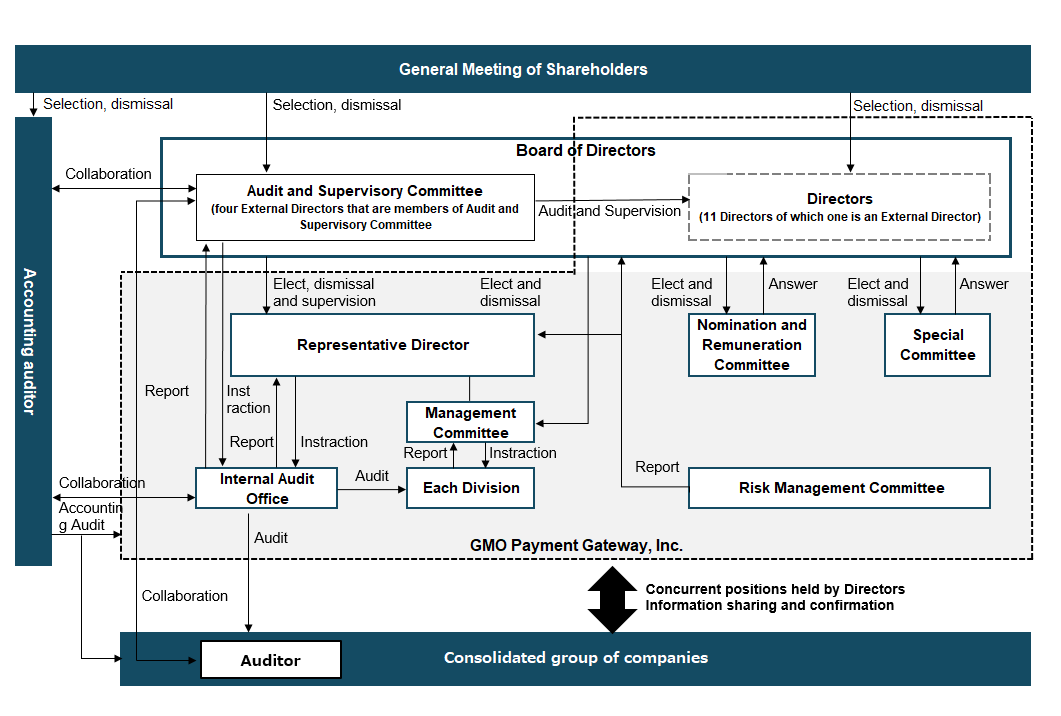
・The Board of Directors
The Board of Directors is comprised of 15 Directors (including 5 external directors) . The Representative Director functions as the chairperson of the Board. The Board convenes its regular session once every month and can hold extraordinary sessions when necessary to resolve important management and legal issues. In addition, the Board supervises the execution of duties of Directors, and endeavors to secure the fairness, efficiency and transparency of the decision-making process. Furthermore, the term of office of a Director excluding members of the Audit and Supervisory Committee is one year, in order to establish a management system that can respond agilely to the changes in the business environment and clearly define the Director's management responsibility. Moreover, the term of office of a Director who are members of the Audit and Supervisory Committee is two year.
・Audit and Supervisory Committee
The Audit and Supervisory Committee consists of four External Directors. Based on the Rules of the Audit and Supervisory Committee, each member must share and partake in the task of attending the Board of Directors meetings and other important meetings as well as share in conducting investigations of operations and financial condition, etc. In addition, the Audit and Supervisory Committee carries out supervision through such activities as receiving reports and issuing instructions when necessary to / from the Internal Audit Office.
・Management Committee
The Management Committee is the decision-making body for the execution of important business operations in order to strengthen the management oversight function through the separation of supervision and execution. The Management Committee is comprised of the Representative Directors and some Directors and Executive Officers, and convenes once a month or more, in principle. The Management Committee is formed to facilitate the efficient execution of operations, and make timely and appropriate decisions through deliberations on important matters related to the execution of operations carried out in accordance with the Basic Policy of the Board.
・Nomination and Remuneration Committee
The Nomination and Remuneration Committee is a voluntary body covering matters pertaining to nomination and remuneration of Directors (excluding member of the Audit and Supervisory Committee) . The Nomination and Remuneration Committee is comprised of five Directors (of which, three are External Directors) and is chaired by an External Director. The Nomination and Remuneration Committee acts as an advisory body to the Board of Directors and make proposals to the Board of Directors whenever necessary, on matters concerning appointment policy of Directors, screening of candidates, Director's remuneration system, remuneration amount, and succession plans for the role of Representative Director by carrying out fair and objective deliberations.
・Internal Audit Office
The Company has established the Internal Audit Office, where three dedicated staff members are assigned to conduct audits regarding key risks and internal controls of the Group. Specifically, in accordance with the "Rules on Internal Audit" set by the Company, internal audits are conducted on each department and subsidiaries to ensure that operations are conducted in a lawful and proper manner based on applicable laws, the Articles of Incorporation, and internal rules. The findings of the audits are reported to the Board of Directors and the Representative Director, and also explained to the Audit and Supervisory Committee members.
・Risk Management Committee
The Company establishes a Risk Management Committee that undertakes risk management for the overall GMO-PG and its consolidated companies in an effective and efficient manner.
・Special Committee
The Special Committee acts as an advisory body to the Board of Directors and consists of five external directors vested with the responsibility to deliberate on important transactions and actions with conflict of interest between controlling and non-controlling shareholders.
Continual Improvement of Governance
・Selection Policies and Nomination Procedures of Directors
The selection of Directors makes due consideration of Directors who are equipped with the knowledge, experience and skill to effectively carry out their role and responsibility and will be mindful to achieve the appropriate size and diversity (in terms of nationality, gender, and age) of the Board. Candidates for Directors will be selected on these policies and following the deliberations at the Nomination and Remuneration Committee, will be formally proposed to the Board for the decision.
・Independence Standards for External Directors
In making the decision for designating External Directors including members of the Audit and Supervisory Committee as independent Directors, the Company designates as independent Directors those who fulfill the proprietary standards set forth in the Independence Standards and Rules for External Directors.
・Evaluating the Effectiveness of the Board
The Company strives to improve the effectiveness of the Board by incorporating evaluation and analysis once a year at the Board meeting, carried out primarily by the Audit and Supervisory Committee.
More concretely, the Company works to ensure the Board's effectiveness based on a broad perspective that is not limited to the composition and operations, but also including the organizational design, nomination and remuneration by incorporating objective and quantifiable methods, such as questionnaires completed by all Directors.
Concurrently, the issues revealed in the evaluation process are continuously addressed through formulating and executing on improvement measures, in order to further enhance the Board's functioning.
・Director's Remuneration
In order to secure the transparency of the remuneration determination process and the appropriateness of the remuneration, the Company establishes the Nomination and Remuneration Committee that acts as an advisory body to the Board of Directs and is chaired by an External Director. The remuneration (including bonus and other remunerations) for Directors (excluding members of the Audit and Supervisory Committee) is decided by the Board of Directors following due deliberations by the Nomination and Remuneration Committee.
The remuneration for each individual Director is decided by the Board and is deemed to basically align with the report and determination policy set forth by the Nomination and Remuneration Committee, following the Committee's multi-faceted considerations including the consistency with the policies adopted. Furthermore, the remuneration of Directors who are members of the Audit and Supervisory Committee consist only of a fixed remuneration amount in the interest of securing independence and objectivity from management, and the fixed remuneration amount is decided through discussions in the Audit and Supervisory Committee.
Furthermore, in order to further advance sustainability management, ESG indicators have been incorporated into the individual target of the Director in charge from FY ending September 2022.
Directors' Skill Matrix
| Name | Position | Practice of GMO-ism *1 | Corporate Management | IT/Security | Risk Management | Legal Affairs | Treasury and Accounting | Payment Processing Business | Finance | Global | Investment (M&A) |
ESG/ Sustainability |
Attendance rate for Board meeting *2 | Attendance rate for Audit and Supervisory Committee *2 | Attendance rate for Nomination and Remuneration Committee *2 |
|---|---|---|---|---|---|---|---|---|---|---|---|---|---|---|---|
| Issei Ainoura | President and Chief Executive Office |
〇 | 〇 | 100% | - | - | |||||||||
| Masatoshi Kumagai | Chairman and Director |
〇 | 〇 | 66% | - | - | |||||||||
| Ryu Muramatsu | Director, Executive Vice President |
〇 | 〇 | 〇 | 〇 | 〇 | 100% | - | - | ||||||
| Satoru Isozaki | Director, Executive Vice President |
〇 | 〇 | 〇 | 〇 | 〇 | 100% | - | 100% | ||||||
| Masashi Yasuda | Director | 〇 | 〇 | 〇 | 88% | - | 100% | ||||||||
| Hirofumi Yamashita | Director | 〇 | 〇 | 94% | - | - | |||||||||
| Teruhiro Arai | Director | 〇 | 〇 | 〇 | 88% | - | - | ||||||||
| Noriko Inagaki | Director | 〇 | 〇 | 〇 | 88% | - | - | ||||||||
| Yuki Kawasaki | Director | 〇 | 〇 | 94% | - | - | |||||||||
| Takashi Shimahara | Director | 〇 | 〇 | 〇 | 〇 | 94% | - | - | |||||||
| Fumio Kai | External Director | 〇 | 〇 | 〇 | 〇 | 88% | - | - | |||||||
| Masayuki Hizikuro | External Director, Audit and Supervisory Committee | 〇 | 〇 | 〇 | - | - | - | ||||||||
| Kazuhiko Okamoto | External Director, Audit and Supervisory Committee | 〇 | 〇 | 〇 | 〇 | 100% | 100% | 100% | |||||||
| Yumi Hokazono | External Director, Audit and Supervisory Committee | 〇 | 〇 | 100% | 100% | 100% | |||||||||
| Osamu Ohkawa | External Director, Audit and Supervisory Committee | 〇 | 〇 | 〇 | 100% | 100% | - |
*1 GMO-ism is the collective name for GMO Internet Group's company philosophy, values and motto, including "Venture Spirit Declaration."
*2 Number of Board meetings convened: 18; Number of Audit and Supervisory Committee meetings convened: 15; Number of Nomination and Remuneration Committee meetings convened: 2
Raising Awareness of Participation in Management through the Employee Stock Ownership Plan
Based on our ideology of "Everyone is the President," we aspire to foster all partners (employees) to incorporate the same perspective as the management team in carrying out business activities to realize sustainable growth. The Company establishes the Employee Stock Ownership Plan to further raise awareness of participation in management by the partners and to aid in their asset accumulation. Partners can purchase the Company's shares from small installments, and the Company provides a 10% incentive payment for such share purchases. As of the end of September 2024, the participation rate in the Employee Share Ownership plan is 34%. Each partner continues to strive to raise the corporate value by sharing the same values as our general shareholders.
Engagement through IR Activities
The Company carries out timely disclosure of management information and investor relations (IR) activities for shareholders and other investors to enhance the transparency of management in order to achieve the aims of corporate governance.
Summary of Activities for FY2024 (from October 1, 2023 to September 30, 2024)
| Activity | Number of Events |
|---|---|
| Financial results announcements and briefings | 4 times |
| One-on-one meetings | Approx. 490 |
| Participation in broker conferences | 9 times |
| Overseas IR roadshow | 1 time |
| Number of meetings including group meetings | Approx. 540 |
Risk Management
Status of Risk Management Structure
In order to tackle the various risks associated with business operations, the Company has developed a risk management structure to secure stable growth and business continuity by optimizing and deploying costs required to carry out preemptive measures on a permanent basis. Specifically, based on our established "Risk Management Regulations," the Risk Management Committee has been established, comprised of the heads of divisions at GMO-PG and its consolidated companies, to carry out risk assessment, the formulation and execution of countermeasures, as well as monitoring. This Committee comprehensively evaluates and manages various risks including compliance risks such as anti-corruption, natural disaster-related risks including climate change and risks associated with system security, among others. The Board of Directors supervises the effectiveness and appropriateness of corporate-wide risk management based on periodic reports on the discussions and evaluations of the Committee. Note that, due to the above initiatives, there have been no scandals nor material wrongdoing during FY2024.
Information Security
Basic View
The Company's mission is the realization of a secure and convenient cashless payment for consumers and business operators by aiming to become the infrastructure of Japan's payment process. In conducting corporate activities aligned with this mission, the Company is engaged in information security measures based on the awareness that protection of information assets from external threats is the highest management issue as well as in utilizing the proprietary information assets.
Specifically, necessary measures are in place such as internal rules, 24-hour system surveillance and security measures against malicious infiltration both from within and outside the Company to prevent cyber-attacks and computer viruses and other malicious infiltration of computers.
Additionally, yearly educational and awareness-raising activities are scheduled to ensure that these measures take root.
Thorough education is periodically conducted at the start of employment using compliance training programs to ensure a deeper understanding of procedures, the purpose of security rules, basic policies and rules stipulated under the information security management system (ISO27001). These are combined with awareness raising videos on information security measures. Additionally, improving the effectiveness of risk assessment is also carried out by inviting external experts to participate in the Risk Management Committee and by assigning employees with specialized knowledge to the Internal Audit Office.
Risks and Responses to Information Security
①System Failure and Information Security
・Risk : Risk of service disruptions caused by unforeseen system failures on the part of payment providers (such as credit card companies) and/or weaknesses in the Company's systems that result in the disruption of communication networks and the malfunctioning of applications caused by cyberattacks, computer viruses, and/or unauthorized computer access from an external source or natural disasters or accidents.
・Response : The following requisite and appropriate responses are enacted to mitigate risks, such as security measures against unauthorized access from external and internal sources, a 24-hour surveillance structure, duplication of system configuration, insurance policy enrollment, and development of internal rules on operations.
②Credit Card Information Breach at Merchants
・Risk : Risk of joint liability to cover the indemnity cost of reissuing credit cards when the merchant, etc., does not have the capacity to fulfill the obligation in the event of information leakage of credit card information occurring at the merchant.
・Response : In order to mitigate this risk, the Company undertakes strengthened management of merchants that store such information as well as promotes services where the credit card information is stored by the Company and not by the merchant.
③Potential Breach of Personal Information and Its Impact
・Risk : Risk of external leak of database information managed by the Company that contains personal information such as credit card information, names, addresses, telephone numbers, and email addresses.
・Response : The Company has implemented a solid system that qualifies for the PrivacyMark in order to ensure against this risk. In addition, as a member of the Japan Consumer Credit Association, personal information management operations are implemented in accordance with the Personal Information Protection Policy. Furthermore, the Company established the Risk Management Committee to implement effective and efficient risk management. The Risk Management Committee convenes once every quarter and reports its findings on risk management to the representative directors, Board of Directors, and Audit and Supervisory Committee.
The following certifications for information security have been certified as measures to strengthen the risk management structure.
・Acquired accreditation for compliance for ISO27001
Acquired accreditation for compliance for ISO/IEC 27001:2022(JIS Q27001:2023), the global standard for information security management applicable to all of the Company's business locations
・Acquired PrivacyMark certification
In recognition of the appropriate measures to safeguard personal information, the Company received the PrivacyMark certification that signifies compliance with the Japanese Industrial Standard for personal information protection, JIS Q15001:2017.
・Fully PCI DSS Compliant
The Company's services are in full compliance with version 4.0.1 of the PCI DSS global security standard for the credit card industry, which was jointly formulated by the five global credit card brands: JCB, American Express, Discover, MasterCard and Visa. As such, we are delivering peace of mind to all of our customers, in addition to securing credit card payments.
Compliance (Legal Compliance)
Compliance
The Company considers the scope of compliance that includes: a) laws and ordinances, b) ethics and social norms, c) rules, regulations, and procedures, and d) management vision. The Company works to raise the compliance mindset of all partners based on the awareness of "adapting to the demands of society" (known as the full-set compliance), which includes adherence to related government laws and ordinances.
Under the Rules of Compliance Management and Internal Rules Regarding Misconduct, all incidents of misconduct including compliance violations that occurred or is likely to occur must be reported to Corporate Support Division promptly, and the Corporate Support Division is stipulated to carry out necessary investigation and implement the required and appropriate response for resolution, as well as formulate and disseminate the preventative measures, with due reporting and collaboration with Corporate Support Division.
The Internal Audit Office reviews the state of compliance with ordinances, articles of incorporation, company rules and other such regulations based on the yearly Audit and Supervisory Plan. Corrective measures are undertaken if a circumstance is found to require improvement as well as follow-up to ensure these corrective measures are enforced. If an incident where a compliance violation is suspected occurs, the Company has developed and operates a whistleblower system in addition to the normal reporting system based on chain of command.
Note that no costs related to compliance violations, including penalties, fines and settlement payments related to corruption, have been incurred in FY2023.
Code of Conduct
The Company acknowledges the importance of compliance with laws and regulations, improving and maintaining corporate and employee ethics which is compiled into the Code of Conduct and carries out regular awareness-raising and other efforts to partners (employees).
The Company's intention encompasses the full set of compliance which is not limited to compliance to laws and regulations, improving and maintaining corporate and employee ethics but also to & #39; adaptation to social demands.' In order to put this into practice, the Company strives to preemptively prevent the occurrence of any problems through compliance with internal rules and an open and smooth communication in the work environment. On the other hand, in case a problem arises, the issue is reported and consulted with the line manager and there are systems in place to enable a speedy, effective and suitable improvement measures.
With the help of such initiatives, partners of the Company are entrusted to act in a responsible and sensible manner and internalize the Code of Conduct as a guiding principle of their daily behavior.
Anti-Corruption
Basic View
The Company's Code of Conduct for Directors and Employees stipulates related anti-corruption clauses including compliance with Act on Prohibition of Private Monopolization and Maintenance of Fair Trade (the Anti-Monopoly Act), acts of conflicts of interest, prohibition of gift-giving or entertainment of public officials or those deemed to be as well as overseas public officials or those deemed to be, prohibition of gift-giving and entertainment in excess of socially acceptable levels to business counterparts, measures on anti-money laundering and other similar acts and, contributions and charitable donations that abide with laws and ordinances.
Anti-Corruption Initiatives
The Company carries out the merchant management assessment on merchants that are likely to enter into a commercial transaction with the Company, to assess whether the business of the merchant is offensive to public order and standards of decency.
The Board of Directors monitors the compliance of GMO-PG and its consolidated companies by receiving regular reports on the compliance initiatives and its implementation from the officer in charge of compliance.
The Company has established a whistle-blower reporting system internally and externally that ensures confidentiality, fairness and objectivity.
The Company continuously works to disseminate the Company's principles and messages from top management that are related to compliance and foster a compliance culture through periodically reading aloud and debates. In addition, the Company conducts regular training and follow-up sessions in order to educate and thoroughly disseminate the significance and importance of compliance management as per the Rules on Compliance Management.
Note that there were no individuals subject to disciplinary action or dismissal due to violations of the Code of Conduct related to anti-corruption during FY2024.
Political Donations
The Company does not make political donations.
Tax Policy
Tax Policy
Basic View
Under the management principle to "By contributing to society, we pursue both spiritual and material prosperity for our partners." the Company contributes to the economy and local community of that jurisdiction through the fair and full payment of taxes. The Company appropriately files and pays the taxes based on the relevant laws and regulations on taxation of that country/region in which the business activity takes place. In addition, the Company will endeavor to optimize its tax cost through the use of tax incentives and benefits within the scope of legitimate business activities. The Company will not engage in arbitrary tax avoidance measures to make unreasonable and unjust use of tax havens and excessive tax planning on non-existent businesses, nor abuse tax incentives in a manner not aligned with the purpose stated in the relevant tax law.
Tax Governance
The Executive Vice President of the Company, overseeing corporate operation, bears responsibility over tax governance, and the Accounting Division carries out the taxation operations under the management and instructions from the General Manager of Accounting & Finance Management Department. Consideration of taxation risks is carried out with the advice from external advisors. Occurrence of material problems related to taxation is reported to the Board of Directors.
FY2024 Tax Payment by Country
| Country | Tax Payment |
|---|---|
| Japan | 144.1 |
| U.S | 2.0 |
| Other (Southeast Asia, India, etc.) | 1.1 |
* Compiled figures for corporate taxes, etc.
VIEW
If you have any questions or consultations about our services, please contact us.
Please feel free to contact us from the following.