


Taiwan Inbound Marketing Seminar
payment, ad tech, and media companies! Latest promotion example ~
~ Seminar Report ~
Seminar outline
theme
Taiwan Inbound Marketing Seminar-payment, ad tech and media companies! Latest promotion example ~
event date
Friday, June 24, 2016
Place
GMO Payment Gateway, Inc. Tokyo / Shibuya Headquarters
(Humax Shibuya Building 7F, 1-14-6 Dogenzaka, Shibuya-ku, Tokyo)
Teacher
Part 1 MATCHA Co., Ltd. Executive Officer Keisuke Yamada
Part 2 Vpon Japan Co., Ltd. Sales Headquarters Sales Manager Kensuke Aida
Nobuo Hayakawa, Manager Global Business Management Department, GMO Payment Gateway, Inc.
Overview
In response to the growing demand for inbound tourism to Japan due to the recent increase in tourists visiting Japan, marketing activities to attract tourists from overseas are now indispensable for domestic businesses.
Under such circumstances, this time we will focus on Taiwan, which is one of the countries with the largest number of so-called active tourists visiting Japan, which can be seen from the frequency of visits to Japan and the high degree of pro-Japan, and a business approach to "overseas". Is unraveled from the three angles of "media," "ad tech," and "payment
We sent an inbound marketing seminar for Taiwan co-sponsored by three companies that have strengths in "media visiting Japan," "mobile ad network," and "global payment
[Part 1] Japan's present as seen by Taiwan, which can be understood only by operating media for foreigners visiting Japan
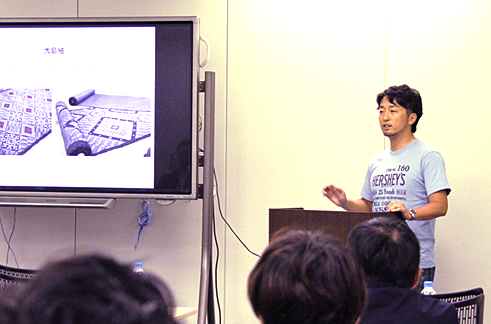
In the first part, Mr. Yamada, an executive officer of MATCHA Co., Ltd., which develops services for foreigners visiting Japan, took the stage.
MATCHA operates the WEB media "MATCHA" for foreign tourists visiting Japan, and although it is a very young company established in 2015, MATCHA already has about 2.5 million accesses per month, 211 countries, and It is an information site for visiting Japan with carefully selected contents that attracts "Japanese lovers" from all over the world, which is viewed by users from the region.
The contents of MATCHA are mainly divided into the categories of "food", "sightseeing spots", "events", "Japanese culture", "shopping", "nerds", and "accommodation". There is also a category called "How To" that helps tourists travel efficiently and comfortably, such as how to buy electronic tickets and how to use chopsticks.
What is interesting is that the output languages include "Japanese" and "Easy Japanese". In fact, one of the characteristics of MATCHA is that "I want to be different from other people" and "I want to go to places where everyone doesn't go much" rather than the tourist spots and information on the royal roads covered by all the media visiting Japan. The point is that you can find a lot of so-called "niche" content that attracts tourists to Japan. Therefore, we will make it possible to see the contents in Japanese so that we can convey such "goodness of niche Japan" to Japanese people, and for tourists from overseas who are stubborn to some extent and international students studying Japanese. Is always providing new content in "easy Japanese".
The theme of this seminar is "Taiwan", but since most of the visitors from Taiwan visit Japan more than once, the second and subsequent seminars are "Niche Japan" mentioned earlier. Many travelers seek "goodness". In fact, such needs and MATCHA content are well matched, and Taiwan is one of the countries with the most access to MATCHA. Visitors from Taiwan seem to value the fact that they have been to Tokyo and where they have gone and what new things they have seen. Mr. Yamada says that the characteristic of Taiwanese users is this "niche exploration" while creating content for visiting Japan with people from various countries.
Mr. Yamada also introduced the trends and real voices of Taiwanese people who actually researched MATCHA's Taiwanese writers, but there were many interesting episodes and nodded at the seminar venue. Participants listening to the story were often seen. In inbound marketing to Japan, it was a session that showed how important it is to actually know the trends and thoughts of the target.
[Part 2] Taiwan's inbound market and advertising methods
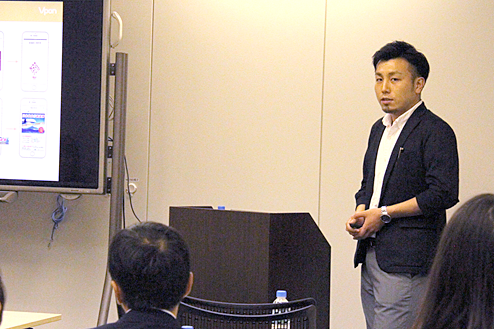
Next, Mr. Aida, a sales manager at Vpon Japan Co., Ltd., took the stage in the second part.
Vpon advertising delivery to mobile apps linked with its huge amount of marketing data, and provides a service that has the advantage of reaching tourists from Greater China. It is expanding.
The advertising reach of Vpon's network has reached about 20 million people, and in particular, delicate targeting such as "users who are interested in Japan" and "users who are planning to visit Japan" by linking data with third parties such as major Chinese media. Has a good reputation for appealing by, and has many clients of major national / global brands.
Since Vpon is also headquartered in Taipei, the content of local research is deep, and Mr. Aida introduced the trends of Taiwanese users with various data. According to Taiwanese tourists' visit data and questionnaires, Taiwanese people often stay for about 1 to 2 weeks on average when they visit Japan, and preparations such as airline ticket / accommodation reservations and sightseeing plans are 1 It is said that it is common from 2 months ago. advertising delivery menu on Vpon is also broadly divided into "Travel Mae (before visiting Japan)" and "Travel Naka (during visiting Japan)".
Listing ad such as Facebook, Google, and Yahoo, which are also popular in Taiwan, and posting on the media visiting Japan such as MATCHA, we are in the promotion phase such as utilizing popular bloggers who are the mainstream in marketing in Taiwan. He explained about digital measures that are often used in combination with Vpon, with examples.
Mr. Aida pointed out four main points in developing a promotion for Taiwan: "medium- to long-term promotion," "securing the volume of viewing times," "mobile focus," and "posting innovative information." But above all, the final "posting novel information" may be the most important for Taiwanese users who are accustomed to Japan. Perhaps it is a necessary point in advertising to always send out "Japanese trends that everyone does not know yet" to Taiwanese users.
At the end of this session, Vpon announced a proposal for a special advertising promotion campaign exclusively for the participants of this seminar, and I think the participating companies were also motivated.
[Part 3] Taiwan EC situation and cross-border / local payment
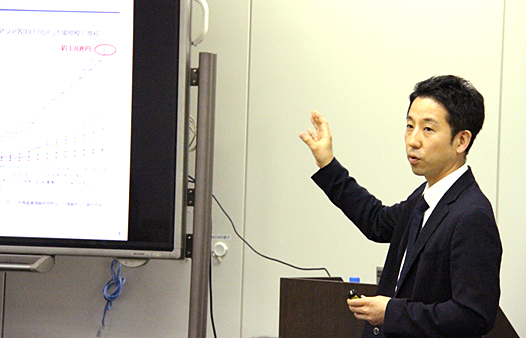
In the third part, which is the final session of this seminar, Hayakawa will take the stage from our Global Business Management Department, and will payment and market trends surrounding Taiwan from macro data to qualitative features, mainly in Southeast Asia. I explained the data and approach methods for expanding business overseas.
In the vicinity of East ~ Southeast Asia, excluding mainland China, Taiwan is one step ahead of other countries (Malaysia, Thailand, Singapore, etc.) in terms of the scale of the e-commerce market (distribution), and the e-commerce market is expected to grow more and more in the future, especially in the apparel, cosmetics, and health food fields.
Taiwan is one of our global payment processing business regions, and there is a very high need not only for inbound visits to Japan but also for cross-border e-commerce.
Looking at Asian countries from the perspective of payment, it is very interesting to see that the main payment method differs depending on the region. In the Japan where we live, Credit card payment is relatively mainstream when it comes to online shopping, but in Taiwan, CVS Payment is widely used, especially among young people. One of the reasons for this is that convenience stores are found here and there in Japan country, but convenience stores are more popular in Taiwan than we feel in Japan (in fact, Taiwan's convenience store penetration rate is said to be the best in the world).
In this way, different payment method will change the way the site is created. If the design of the site changes, the marketing methods will also change. payment Even if the website does not require introduction, it is important to grasp the local market information quantitatively and qualitatively, not only payment.
In addition, Hayakawa explained that there are three steps when expanding overseas business from Japan to neighboring countries such as Southeast Asia, not only in Taiwan, but also in the Southeast Asian region: (1) "cross-border EC" from Japan to overseas, (2) "test EC" through sales agency, and (3) "overseas local EC" to establish a local subsidiary and develop it in earnest. In addition to explaining our payment service model, we also explained the differences between each payment method.
[Voice of seminar participants]
"I have come to have a fairly concrete image of visitors from Taiwan. I would love to hear from you on themes of countries other than Taiwan."
"I got a good idea of overseas information that is difficult to understand when I'm only in Japan."
"Although I understand the increasing trend of tourists visiting Japan, I couldn't get any concrete data or images of approach methods, so I learned a lot by attending this seminar."
"Joint seminars at multiple operating companies are very rewarding and rewarding. I would like to continue participating in similar seminars."
We would like to thank all the companies who participated in the event.
We will continue to hold seminars to provide useful IT business and marketing information for your business.