


[How to utilize Google Analytics to create site improvement measures]
-"Design" "Basic indicators" "Basics of data analysis"-
~ Seminar Report ~
Seminar outline
theme
[How to utilize Google Analytics to create site improvement measures]
-"Design" "Basic indicators" "Basics of data analysis"-
Date and time
Thursday, June 2, 2016 14: 00-16: 00
Place
1-14-6 Dogenzaka, Shibuya-ku, Tokyo Humax Shibuya Building 7F
Teacher
GMO Payment Gateway, Inc. Customer Attraction Support Department Yu Sugawara
Overview
Google Analytics continues to attract a lot of attention as an indispensable presence for improving site performance. It is a useful tool that can measure user behavior for free, and some companies have a dedicated person in charge, but the reality is that there are many sites that stop at the stage before the start of use because the settings do not go well.
Therefore, this time, Sugawara of GMO Payment Gateway, Inc., Ltd. will give a lecture to EC site staff based on basic knowledge, setting methods and points that the staff can easily trip over so that they can reach the previous stage that can be used for site improvement measures. rice field.
Part 1 Google Analytics Design for Accurate Data Measurement

According to Sugawara, if the degree of utilization of Google Analytics is divided into five stages, it is finally possible to contribute to the business in the fourth stage. However, many sites are still in the first or second stage, and there seems to be a big problem here.
First of all, the first and second stages. The first thing to do is to set the tag and set the management screen. In this seminar, we picked up 6 indicators that are especially important for EC staff and gave instructions on how to set them one by one. This makes it possible to check basic indicators on the management screen.
However, even if the design can be done so far, there are pitfalls that the person in charge can easily fall into. In the case introduced by Sugawara, it is due to factors outside the setting screen (site renewal, domain change, etc.), and there is a high possibility that the person in charge cannot find a solution by himself. In other words, Google Analytics often requires specialized and cross-cutting knowledge about websites, and these factors may also create demand for outsourcing settings and management.
Part 2 Google Analytics Basic Indicators and Data Analysis Basics
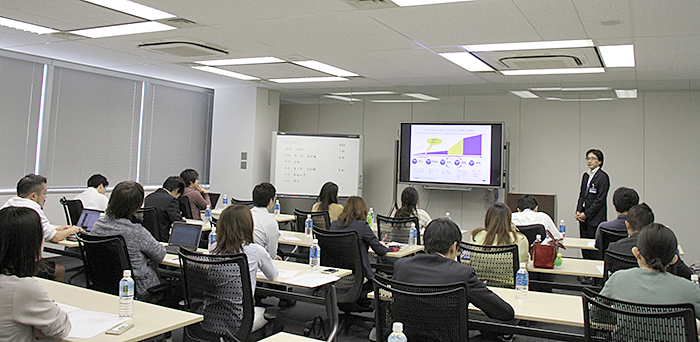
In the second part, lectures were given with the aim of being able to analyze and improve in the 3rd and 4th stages of the 5 levels of utilization.
In the analysis, Sugawara emphasizes the importance of accurately grasping the meaning of the indicators. For example, instead of calling the number of user visits to the site "access count", it is correct to use "session count" and "page view count" according to the context. In utilizing analytics, which has a large number of unique technical terms, these basic things are very important for smooth communication inside and outside the company.
The content of the lecture will gradually strengthen its specialty as the latter half of the lecture. "Secondary dimension", "weighted sorting", and "content analysis" are mentioned as indicators that should be noted in the analysis, and explained in what kind of scene they are used. At the 4th stage of utilization for measures, the direction of measures was introduced from the viewpoint of the amount of content until purchase and the site UI.
To conclude, Google Analytics can be used not only as a site analysis tool but also as a guideline for management decisions, so the significance of disseminating its usefulness within the client side was stated, and the two-hour lecture ended with a great success. Closed.