


For EC site managers "Native ads that you must understand in 2015"
~ Seminar Report ~
Seminar outline
theme
Held in February 2015
For EC site staff "2015, a" native ad "that you definitely want to understand"
Date and time
Wednesday, February 4, 2015 13: 30-15: 15
Place
GMO Payment Gateway Tokyo Head Office Large Conference Room
Teacher
Part 1 GMO Payment Gateway, Inc. Customer Attraction Support Department Consultant Yuta Kobayashi
Part 2 News Technology Co., Ltd. Director Nanami Nishi
[First half] Correct understanding of native ads
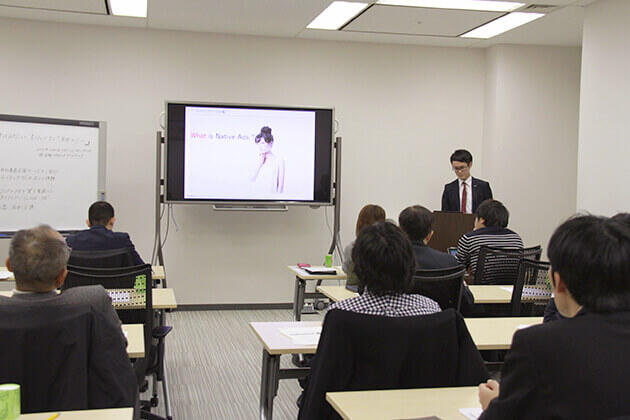
Our consultant, Yuta Kobayashi, will be on stage for the first part. It is difficult to grasp the actual situation of what you often hear, and we introduced the definition of native ads, the background of attention, the main services, and the points to lead to success.
The definition of native ad refers to "a content-rich advertisement that provides the pure content of each advertising medium and the same UI (user interface = design) and similar UX (user experience = user experience)". As a result, he said that high CTR (click-through rate), article viewership, branding effect, and CVR (conversion rate) can be expected.
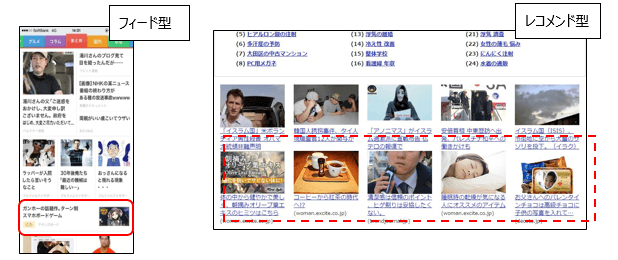
There are six types of distribution types, such as the "feed type" that is often used for smartphone distribution and the "recommendation widget type" that is posted at the bottom of articles on information sites. There are many ways to deliver it, but the important thing here is to understand native ads from the perspective that "no matter how much the ad has the same UI design as the content, it is the same as a normal ad as long as it does not provide the same user experience."
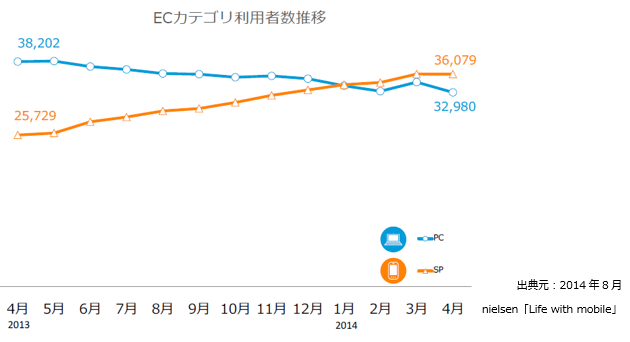
Next, he mentioned why native ads came to the spotlight. As a background, he pointed out the emergence of problems with existing promotions due to smartphone shifts.
- • Deterioration of cost-effectiveness of smartphone advertising
- • Decreased CTR (click-through rate) for banner ads
On the EC site, although smartphones are reversing PCs due to the number of users, smartphones have a lower CVR (contract rate) than PCs, so promotion can be shifted to smartphones even though the number of accesses is increasing. There is a dilemma that is not.
Also, compared to the early 2000s, the CTR (click rate) of banners has dropped to less than one-tenth, and "67% of clicks" are "heavy clickers of 4% of all click users." There is survey data that says.
Under such circumstances, how should we approach the end user? He explained that native ads are booming as an answer to the question.
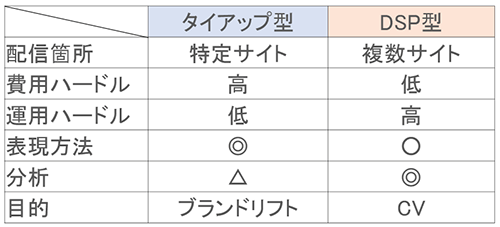
How can I use native ads based on the definition and background?
There are two main methods, and which one matches depends on the purpose.
- [1] Tie-up type native ad
A method of distributing a specific amount within a specific medium.
CockPad, IQON, mery, etc. are famous.
It is suitable for expanding product awareness and brand awareness. - 【2】 DSP Type Native Ads
A method of distributing to multiple media via DSP. It requires operation, and there are many cases of CPC (cost per click) billing, and it can be used from a small amount.
BLADE PR and logly lift are the most popular.
It is suitable for EC in general and the Phase of trying out native ads.
Finally, I gave three points for the success of native ads.
- 1. Serve as content
→ content that you find useful and interesting in addition to letting people know about your brand and services. - 2. Meeting user expectations
→ try to transition to the page so that it does not disappoint users who click on it because they think it looks interesting. -
3. It is only an advertisement
→ content is important, but be aware that it is an advertisement. Set goals and follow the PDCA cycle to achieve results.
Kobayashi concluded the first half of the seminar with the hope that the content of the seminar would lead to increased sales and breaking through the status quo for franchisees
Is cited as a particular factor.[Second half] DSP x PR "Native ad with an emphasis on quality" -BLADE PR-

From the overview of native ads in the first half, we went one step further in the second half, and Mr. Nishi of News Technology Co., Ltd. took the stage to introduce Japan's largest DSP-type native ad distribution service "BLADE PR" and explain actual usage examples. It was.
BLADE PR, a native ad distribution service, is a service launched and released by MicroAD, one of the largest ad platform operators in Japan, and Vector, a strategic PR company partially listed on TSE, as a joint venture.
The background to this is that in the past online advertisement, WebPR has focused on approaching prospective customers and the explicit layer, and there have been problems in approaching the latent layer. There is a native ad as a method that can be solved, but the current situation is that it has become an alternative to banner ads, and since it is often transitioned to an LP such as a product page as it is, it betrays the expectations of interested users and serves only as an entrance.
In order to solve such a situation, Mr. Nishi says that he provides native ad services with the philosophy of "providing content from the entrance to the destination of the advertisement."
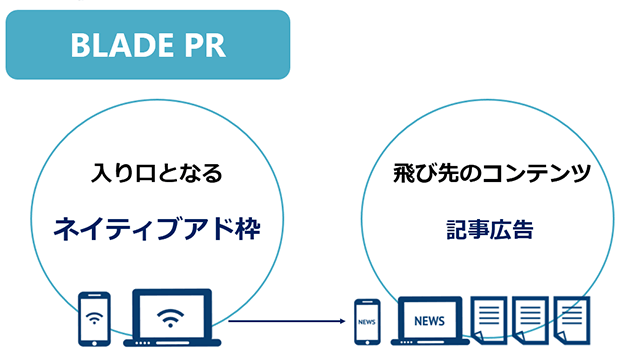

"BLADE PR" is a DSP-type native ad, and is a service that has a feed frame and a recommendation frame as a distribution method (frame).
Each of them can display an advertisement according to the format of the article, and it is a mechanism to judge the match of the attribute of the medium and the content (LP) of the link destination and place the advertisement.
Also, as a basic point related to distribution, but I definitely want you to suppress it,
- • Content-likeness.
- • "Don't fish" in the title
I mentioned two points.
Another feature of BLADE PR is content creation agency from a PR perspective.
By creating content by a third party from a PR perspective instead of creating it in-house, it will be possible to approach users in a different way than before. Specifically, it means having the leading media of the alliance take up the products and services and make an article. At that time, utilizing the DNA of Vector, a PR professional, the point of improving the quality of the content is that News Technology follows from media planning to article publication, and it is evaluated by advertisers. He says.
What attracted the most attention in this lecture was the introduction of specific examples of how to use it to achieve results.
In the first place, native ads are a method suitable for approaching latent layers.
Mr. Nishi proposes, "It is efficient to design latent audiences to deepen their understanding by inducing them with native ads, delivering content, nurturing them to the explicit layers, and reaping them through retargeting."

In fact, there is data that native ads can acquire good potential.
- • High new rate (92-95%)
- • Long stay (5-6 minutes)
- • Low bounce rate (60-70%)
He also said that if the following situations are encountered in the new user acquisition measures of each member store, it is better to implement native ads.
- • Text that is already in progress for retargeting measures will be entered.
- • Current measures have peaked
- •記事広告への興味はあるが、活用方法が分からない
He also enthusiastically listened to the explanation that it is suitable as a method for increasing the new high-quality retargeting list and performing effective pruning.
As an actual example, the example used for promotion of beauty products related to hair and scalp was given.
Two points are set, the viewing time of the content and whether it is appealing to the target group, and the content page using the video using the talent is created as a tie-up article and appealed.
As a result, it was found that the average stay time was 5 minutes and the inflow to the shopping site was 34%, and the content contributed to the inflow. He also said that the target group, which was supposed to be in the age group, accounted for more than 50% of the total, and was able to meet the demands of advertisers as a promotion. Being able to perform detailed analysis is also one of the strengths of "BLADE PR".
Mr. Nishi concluded the second half of the seminar by saying that it is very important to use native ads as a set with content in order to acquire potential users (new users).
[Summary] After the seminar
Thinking of native ads as just a banner distribution slot and just a way to increase inflows and awareness wouldn't work.
I realized again that it is very important to approach which layer of users with which method and appeal content.
We listen to customer requests, anticipate customer journeys, and design approaches. And it is the mission of this customer attraction support department to carry out the advertising agency business by repeating kaizen and producing results that exceed the customer's request, and native ads are an effective means for that purpose.
This seminar was held because there were many voices who did not understand the actual situation of native ads, but even after the seminar, many customers asked questions and consulted individually with consultants, and sales will increase. It was two hours that I got serious.
Voices of customers participating in the seminar From the questionnaire
Company R
“I learned that it is important to design in combination with others, rather than aiming for direct response with native ads alone.”
Company J
"The examples and usage of BLADE PR were very helpful!"
Company N
"I asked GMO-PG for social, but I would like to talk about native ads and other measures!"
We would like to thank all the companies who participated in the event. We will continue to hold seminars that can provide useful digital marketing information for your business.
ネイティブアド、その他広告、弊社集客支援サービスへのお問い合わせ・ご相談は下記まで。