payment Basics
Article published:
Factoring vs invoice Card Payment. Which is the best choice for your business?


Key points of this article
- The strength of factoring is that you can quickly cash out accounts receivable without increasing liabilities.
- invoice Card payments can be deferred by payment and can be used at a low cost as soon as the same day.
- It is recommended to use bank loans in normal times and the above two in terms of cost and time in emergencies.
INDEX
For many companies, "borrowing" using bank loans and institutional loans is the priority as a means of financing for cash flow improvement. This is because the advantage of interest costs compared to other financing instruments is one of the most important factors in maintaining and improving financial conditions.
However, in reality, the following situations suddenly arise where borrowing cannot be reliedupon.
- Urgent funding needs: payment The deadline is a few days away and you can't wait for a review that takes a few weeks ~ 1 month.
- Lack of resources: You are busy with your main job and do not have time to prepare financial statements and business plan statements.
- Screening barriers: Difficult for bank proper loans, such as deficit settlement and tax payment grace.
In such a situation, "factoring" is the next best way for many managers to raise funds. Factoring, which allows you to quickly and quickly cash out your invoice, is a very convenient method.
In recent years, a new cash flow improvement option has emerged as a invoice card payment (BPSP (Business Payments Solution Provider). invoice Card payment is attracting attention as one of the options that can be used more quickly and easily than factoring.
In this article, we will explain the characteristics and criteria for judging the use of "factoring" as an alternative to borrowing and "invoice card payment", a new cash flow improvement method.
What is factoring? accounts receivable How to cash in.
Strengths and weaknesses of factoring that are easier to understand than bank loans
Factoring is a means of financing that does not increase liabilities
Factoring is a mechanism that converts future sales (accounts receivable) into current funds (cash).
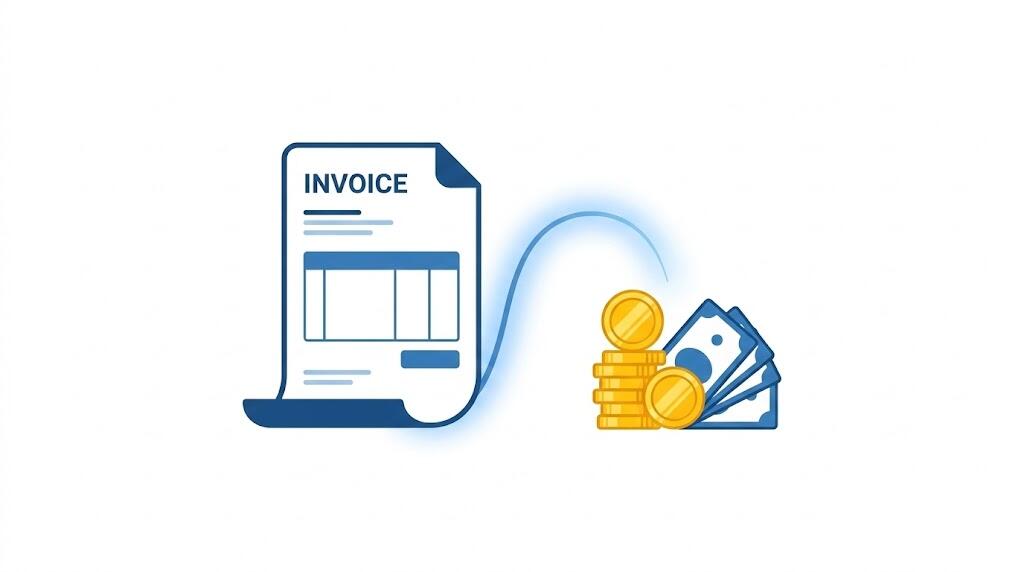
Bank lending is "the act of borrowing new funds in anticipation of future revenue = increasing liabilities", and factoring is "the act of selling and monetizing the assets of accounts receivable that you already hold".
In other words, the big difference is that it is a cash out of assets rather than borrowing, and the impact on the financial situation is different because it does not increase the liabilities and does not worsen the capital adequacy ratio or borrowing capacity.
The "nature of credit" is different from bank loans
In bank loans, the financial situation and future potential of the borrowing businessitself is emphasized. On the other hand, factoring is the nature of purchasing accounts receivable, so the creditworthiness of the accounts receivableis the focus of the examination.
Of course, factoring companiesTo prevent fraud risks such as double assignment of receivables and fictitious recording of receivables、The reliability of the business itself and the actual state of transactionsWe will also examine in detail. However, it is less likely that it will be rejected uniformly due to deficits or borrowing conditions, as is the case with bank loans.
Even if a business using factoring has a deficit or tax arrears, if the receivable is a major company or a reliable municipalities, the hurdles for screening tend to be lowered, so even if a bank loan is refused, factoring may be able to be used.
Factoring is effective for rush financing
Bank loans generally take about one month to be executed because they are strictly reviewed based on various documents (business plan statements, financial statements for multiple periods, etc.) to explain the company's financial situation and future prospects. On the other hand, factoring can be funded in a few business days using invoice and purchase orders as evidence of a contract.
From the perspective of speed from the preparation of necessary documents to the execution, factoring can be said to be effective for urgent financing.
Be careful about factoring fees
While bank loans have an annual interest rate of about 1% to a few percent, factoring incurs a fee of a few percent to 20% per procedure, so the actual procurement cost tends to be high when converted to annual interest rates.
This is because factoring companies bear the risk of unrecovered assets without collateral, and repeated use of easy factoring can greatly reduce profits and put pressure on management.
In order not to use a business that offers fees that deviate greatly from the market price in a hurry to make money, please be sure to check the reliability of the factoring company before contract.
Sorting out the differences between bank lending and factoring
|
Compare items |
Bank Financing |
Factoring |
|
Financial nature |
liabilities increase(borrowing money) |
assets CashOut (Sell accounts receivable) |
|
Main usage scenarios |
Long-term working capital and capital investment |
Short-term payment ・Sudden shorting of funds |
|
Focus of the review |
Your company's financial situationand future potential |
Creditworthiness of accounts receivable・ payment Ability |
|
Execution speed |
About 1 month |
A few business days |
|
Cost (approximate) |
Low(1% to several percent per annum) |
High(5%-20% per time) |
|
Impact on B/S |
liabilities increased, capital adequacy ratio decreased |
liabilities does not increase, cache increases |
contract form of factoring: 2 or 3
There are two main forms of factoring: contract.
Two-Party Factoring
It is a contract form that is completed only by the user and the factoring company. The biggest advantage is that it is not known to business partners. Due to the high risk on the part of the factoring company, the fee is set higher.
Three-Party Factoring
This is a contract form that notifies the business partner (receivable) and obtains their acceptance. Since the deposit is made directly from the business partner to the factoring company, the risk is low and the fee is low. However, there is a risk that business partners may have concerns about "Are you having trouble with cash flow?"
When looking for a factoring company to consult, be sure to check the contract forms they support and be careful not to unintentionally worsen your relationship with your business partner.
In addition, GMO Payment Gateway, Inc. (hereinafter referred to as GMO-PG) provides "GMO B2B Early Payment" as a factoring service.
It supports not only two-party factoring and invoice, but also purchases at the time of the purchase order, and can be used with confidence because it is provided by TSE Prime listed companies.
invoice What is card payment? Bank transfer How to change to credit card payment.
How invoice Card Payment (BPSP) Works
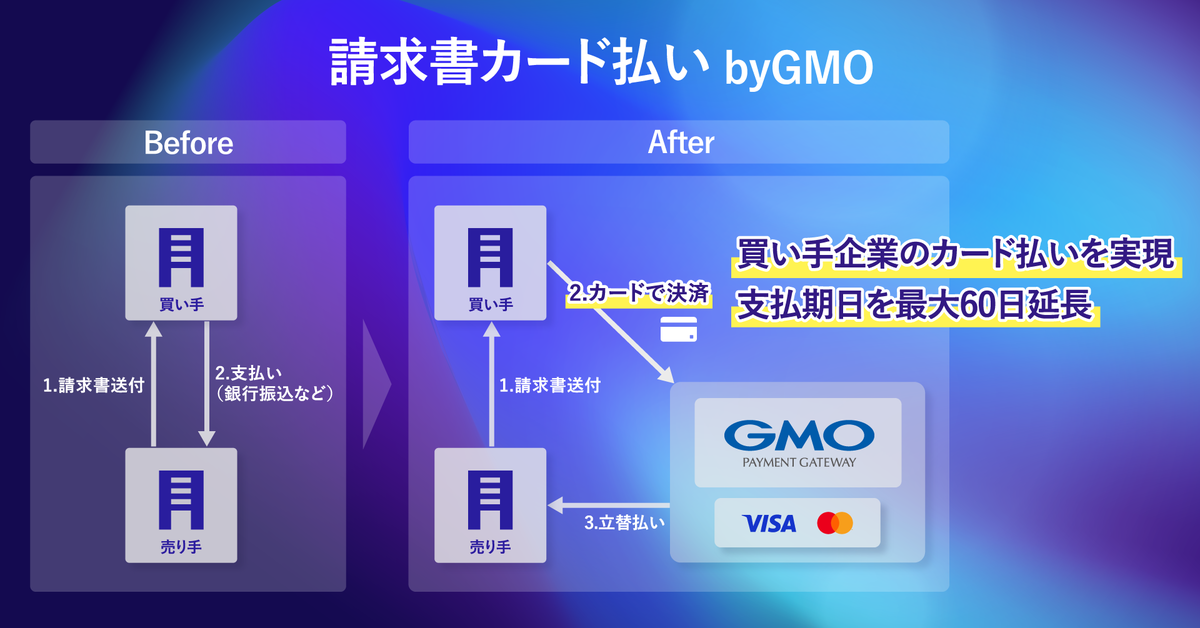
invoice Card Payment (BPSP) is a mechanism that allows buyer companies to payment with credit cards when transacting with sellers that do not support card payment.
Normally, in BtoB transactions, a card payment cannot be established unless both the seller and buyer have implemented a Credit card payment mechanism. However, in invoice card payment (BPSP), the BPSP operator (e.g., GMO-PG) stands between the seller/buyer, accepts the Credit card payment from the buyer company, and remits money to the seller company in Bank transfer to establish the card payment.
You can check out the following article for a more detailed explanation.
Benefits of paying by credit card
By changing the invoice to Credit card payment, it is possible to move the actual payment timing back from "payment on the invoice" to "direct debit" date. Depending on the closing date of the credit card company, there will be a grace period of about 30 days to a maximum of 60 days (*), so it can be viewed as a cash flow control measure to eliminate unexpected fundinggaps, in the same way as factoring.
Available as soon as the same day
invoice Card Payment (BPSP) is used because of its speed of execution. There is no need to wait for document preparation and examination results like bank loans, or document preparation to explain the credit status of business partners like factoring. Simply upload your invoice from the invoice Card Payment (BPSP) user screen to perform same-day transfers, so registering in advance is effective as a preparedness for emergencies.
Cost-Effectiveness and Transparency
Compared to factoring, where fees can reach a few percent to 20%,invoice card payment (BPSP) fees tend to be relatively low, generally around 3.0%.In addition, if you use a service that allows you to designate a Bank transfer holder (such as invoice card payment by GMO), it will only appear to the seller company that the Bank transfer has been executed as usual, and it will be possible to improve cash flow without damaging trust.
Compare factoring and invoice card payments. What is the idea for using different uses?
Factoring vs invoice Card Payment
Comparing invoice card payments from the same perspective as bank loans and factoring, the summary is as follows.
|
Compare items |
Bank Financing |
Factoring |
invoice Card Payment |
|
Financial nature |
liabilities increase(borrowing money) |
assets CashOut (Sell accounts receivable) |
payment Procrastination(saving cash) |
|
Main usage scenarios |
Long-term working capital and capital investment |
Short-term payment ・Sudden shorting of funds |
Short-term payment ・Sudden shorting of funds |
|
Focus of the review |
Your company's financial situation and future potential |
Creditworthiness and payment ability of accounts receivable |
Card availability |
|
Execution speed |
About 1 month |
A few business days |
Minimum same day |
|
Cost (approximate) |
Low (1-3% APR) |
High (5-20%) |
Low (from 3.0%) |
|
Required Documents |
Financial statements, business plan statements, etc. |
invoice ・Bankbook, etc. |
invoice ・Credit card only |
|
Impact on B/S |
liabilities increase |
assets is replaced |
Short-term accounts payable - other |
|
Use of sole proprietorship |
Loan hurdles are high |
Many are limited to corporations |
Available |
Ideas for using them well
The basis of priorities is the balance of "cost" and "time"
The first thing to keep in mind is the idea of "bank loan in normal times when you have plenty of time, factoring or invoice card payment if you can't afford it".
Bank loans, which can be procured at low cost, are a means of financing that should be considered as a priority, and invoice card payments are effective for the purpose of responding to sudden payment and bridging until the timing of payment. This is because in the event of an emergency, such as "next week's payment is 1 million yen short", it can be executed earlier than bank loans, and the cost can be reduced compared to factoring.
Factoring will be effective in aggressive procurement, such as when you don't want to inflate your B/S by cashing out your accounts receivable and using it to purchase more large-scale projects. However, given that the fee is relatively high, it is important to determine when to use it.
Prepare in advance as a safety net to avoid surplus bankruptcy
Since there are various businesses for both factoring and invoice card payment (BPSP), it is not a good idea to rush to compare services after your cash flow deteriorates. We recommend that you prepare in advance from the following perspectives.
Factoring
・Research reliable listed company services and be careful not to touch illegal companies.
・Contact with the partner who corresponds to the desired transaction type, such as two-party factoring or purchase order.
・Know what documents are needed and how much time it takes to prepare.
invoice Card Payment
・Register in advance for services that do not require fixed costs and make them available immediately in case of emergency.
・Use credit card payment when you can afford it and aim to expand your credit limit in the future.
Summary: The number of options is important for management stability
The last thing you should avoid when managing cash flow is to find yourself in a situation where you can't do anything about it.
As explained so far, it goes without saying that bank loans with low interest costs should be the pillar of management. However, in the business field, there will inevitably be sudden payment that cannot be kept up with the bank's sense of speed, or a gap period when loans cannot be obtained due to financial conditions, so it is important to increase your options in advance.
GMO-PG provides factoring services "GMO B2B Early Payment" and "Invoice Card Pay byGMO" in-house, and has a system in place to support all companies in their growth phase. Please consider making inquiries about membership registration and use as a preliminary preparation.
Service Introduction
Invoice Card Pay byGMO
"Invoice Card Pay byGMO" is a BPSP service provided by GMO Payment Gateway that allows you to convert Bank transfer designated invoice to credit card payment.
[Features of Invoice Card Pay byGMO
- payment to Card payment
Regardless of the seller's designation, card payment is possible at the buyer's discretion. - cash flow improvement without borrowing
There is no financing process, and the payment due date can be postponed up to about 60 days later. - Lowest fees in the industry
Low-cost fee settings support continued use.
*There is a prescribed review for use. Also, the extension period depends on the payment day and the date the card is debited.

Author
PX+ by GMO Editorial Department
The PX+ by GMO editorial team is a dedicated media team specializing in the payment and Payment Experience (PX, payment experience) area by GMO Payment Gateway.
payment ・Based on the latest trends and practical know-how related to e-commerce operations and cashless in general, as well as examples of growing companies, we compile and supervise practical and reliable information that is useful for business growth.
Click here for the purpose of "PX+ by GMO" and the list of supervisors.