payment Trend Information
Article published:
authorization What is the approval rate? Funnel from cart to payment completion and 3 improvement steps to maximize profits
Key points of this article
- authorization Explain the specific amount of opportunity lost due to a decline in approval rates and management risks that are often overlooked
- Break down the "payment funnel" from cart loading to payment completion into six processes and define the KPIs to follow
- We propose specific improvement measures to prevent each funnel from leaving the funnel (cart dropout), such as UI improvement, 3D Secure optimization, and error code analysis
INDEX
authorization Declining approval rates are an "invisible bottleneck" that hinders business growth
The "authorization (authorization Integration/Credit Inquiry)" in the Credit card payment of the online transaction is the "last gate" to the completion of the payment. This is not only for management, but also for those in charge and person in charge of leading the e-commerce business, and their importance must have already been keenly aware.
Let me make one important confirmation from the perspective of maximizing sales.
Can you immediately think of a specific number for the most recent "authorization approval rate" on your site and the "annual lost opportunity" that would occur when it dropped by just 1%?
If you are leaving it to the system manager or the payment processing company company, or if you are tracking the overall conversion rate (CVR) but do not see the numbers of the payment funnel alone, you may be neglecting a dangerous "business blind spot" in business growth.
Let's look at specific numbers.
For example, on an e-commerce site with monthly sales of 100 million yen, the rate of payment being bounced (failing) at the authorization stage increases by "1%". The loss caused by this is 1 million yen per month by simple calculation.In a year, 12 million yen of "sales that should have been obtained" are quietly flowing out without anyone seeing.
Despite spending money on advertising to attract customers, displaying attractive products, and having users who decide to purchase add products to their carts, important users are spilling out of the bucket with a hole called "payment", which is the last gate----。 This is an example of the lost opportunities that a authorization approval rate can lead to.
In this article, we will break down the "payment funnel" from cart loading to payment completion. From defining key metrics and KPIs to follow, to specific steps to improve your authorization approval rate.
You can't notice it just by looking at "sales". payment Funnels and Key KPIs
Many e-commerce businesses probably check at least two things: "number of site visits" and "sales". However, there are multiple invisible barriers between when a user puts an item in their cart and when the payment is actually completed.
To accurately identify where users are churning (abandoning their carts), you need to break down and monitor the following six stages (processes) and KPIs:
The GMO Payment Gateway (GMO-PG) defines the process (funnel) from cart entry to payment completion, along with computational logic for key metrics at each stage. These are calculated based on merchant data on GMO-PG's online payment service "PG Multi-Payment Service", which boasts one of the largest payment processing Actual in Japan.
Let's take a look at the points and KPIs that businesses should pay attention to.
*The following process is for trading. The process for registering a credit card through membership registration is different.
PX+ by GMO -- Payment Funnel
Key metrics and KPIs from cart loading to payment completion
Flow image of each stage when cart loading is set to 100
authorization Approvals ÷ Credit card payment Executions
→ Credit card payment Completion Percentage
authorization Requests ÷ 3DS Requests
→ 3DS Authentication Success Rate
Number of successful challenge authentications ÷ Number of challenge certifications
→ Challenge Authentication Success Rate
authorization Approvals ÷ authorization Requests
→ authorization Approval rate
payment Completions ÷ payment Executions
→ payment Completion Percentage
Number of Baskets Dropped ÷ Number of Baskets (Sessions)
→ Abandoned cart rate
Others
3DS Certification
Low risk number
Number of risks during 3DS authentication
(Number of challenge certifications)
Challenge
Successful certification
Failure/
Break away
High risk
* The width is an image of the flow rate when the number of carts is set to 100. Actual figures vary depending on the site, industry, product, and time.
(1) Consideration (basket insertion)
- Important indicators: Number of baskets (sessions), number of carts dropped out (sessions), cartabandonment rate
This process is where the user puts the product in the cart.
Leaving the site without completing the last payment from here is broadly referred to as "abandoned carts."There are various reasons for churning at each point, such as "shipping costs were high" and "account registration was troublesome". Falling out of the basket at payment time also affects the "difficulty of using the payment form" that will appear later. Knowing at what stage the cart is falling outis very effective for improving the site. - Cargo abandonment rate = number of abandoned baskets÷ number of baskets put in (session)
(2) payment Start
- Key Metrics: payment Runs
The number of users who decide to make a purchase and press the checkout button = payment The number of people who proceeded to the checkout screen. How to make the flow from here to payment completion smooth, that is, to provide a "friction-free experience", is how to show off your skills.
(3) payment method Select
- Key Metrics: Credit card payment Runs
This is the phase where you choose a payment method (credit card, Pay, CVS Payment, etc.). In the following steps (4) and (5), we will explain the flow of "Credit card payment", which has the highest utilization rate and is prone to error dropouts.
(4) Identity authentication (3D Secure)
- Important metrics: Number of 3DS requests, 3DS authentication risk rate (low, medium, high),challenge authentication success rate, 3DS authentication success rate
One of the major barriers in today's Credit card payment is EMV 3-D Secure (3D Secure). The card company (issuer) makes a risk judgment on whether the transaction is made by the cardholder himself for each transaction, and it is classified into the following three patterns. - Low risk:smoothly take the next step without additional authentication
- Medium risk: Requires additional authentication such as a one-time password(challenge authentication)
- High risk:Immediately blocked as 3DS authentication NG
Here, how to reduce "cart dropouts caused by 3D Secure authentication" is an extremely important factor in modern e-commerce operations, such as users who are judged to be at medium risk leaving because they do not know their passwords, or being mistakenly judged to be not the person they are even though the transaction was made by the genuine person and not being able to proceed to the next step. - 3D Secure Read more about improving authenticationhere.
(5) authorization (authorization Administration and Credit Inquiry
- Key metrics: authorization Requests, authorization Approvals,authorization Approval Rate
After passing the 3D Secure, the e-commerce business (merchant) conducts a credit inquiry to the card company (issuer) - that is, "Is this card valid payment? This is an inquiry (request). The percentage of approvals returned by the card company for this authorization request is the authorization Approval Rate.
On the other hand, when the approval is not issued at this stage (so-called "credit loss" or "authorization error") and the user abandons the purchase, it is called "authorization-caused cart drop". - authorization Approval Rate = authorization Number of Approvals÷ authorization Number of Requests
(6) payment Complete
- Key metrics: payment Completion rate (= payment Completions÷ Carts Loaded (sessions))
If you break down the funnel like this, even if you say "cart dropped" in one word,
(1) Withdrawal at the consideration stage
(4) Withdrawal by identity verification (3D Secure)
(5) authorization Failure of approval
It can be seen that there are three points with different natures. Visualizing at what points your company is missing out on customers is the first step to illuminating your business's blind spots.
In addition, various expressions such as payment approval rate and authorization success rate are now being seen, but it is also important to note that the calculation logic is different for each company. It is important to understand the "rate" using the numerical value at which point and then consider improvement measures.
Does your site have a high authorization approval rate? Low? The background is
payment Among the funnels, one of the most common black boxes on the merchant side is the key KPI in process (5), theauthorization approval rate. Here's a guide to GMO-PG's authorization approval rates by industry from February Actual * in February 2026, and some of the background that the numbers mean.
*This is a reference value for specific category Actual in February 2026 in GMO-PG. It varies greatly depending on the product, price range, customer attributes, timing, 3D Secure certification, operation, etc.
(1) Product sales (EC): Relatively high level and stability
PG Multi-Payment Service The approval rate for authorization in product sales e-commerce, mainly general product sales and apparel at member stores, is relatively high.
- Example) Product sales category authorization Approval rate: 93.68%
(2) Home appliances and high-priced products: authorization Approval tends to be strict and low
On sites that deal with high-priced products such as home appliances, branded watches, and jewelry, as well as limited edition products that are easy to resell, it cannot be said that "we are safe because we sell products". Sites that handle these products tend to have lower authorization approval rates.
- Example)Home appliance category authorization Approval rate: 79.13%
This is because the fraud detection system on the part of the card company (issuer) works strictly, and there is a dilemma that there are cases where the transaction is not completed even though it is protected by 3D Secure but is originally a payment problem-free transaction.
(3) Digital content and e-books: tend to be lower than product sales
Digital content such as electronic comics, video distribution, and online games tend to have slightly lower approval rates than product sales.
- Example) Information Content Category authorization Approval Rate: 91.45%
This is due to the following reasons:
- Young people: Credit card limits are set low, or "insufficient balance" is likely to occur due to the use of debit and prepaid cards.
- Particularities of usage scenarios:Continuous purchases (adult purchases) in the middle of the night and high-frequency payment in a short period of time are likely to occur, and these behaviors are likely to trigger security locks (fraud concerns) by card companies.
(3) Recurring billing (subscription): Beware of the "Devil's Valley" after the second time
In subscription models such as regular mail order and SaaS, even if the first payment goes smoothly, the approval rate often drops at recurring payment time after the second time.
The main cause is an expired card or exceeding the limit, but if the payment fails here, it will directly lead to "unintentional churn". When it comes to maximizing customer lifetime value (LTV), maintaining approval rates at recurring payment time is truly the lifeblood.
Why is it played in authorization? What is the error (G-code)
If the payment fails due to a failed authorization request, an error code is returned in the payment processing company company dashboard, etc. The following is an example of a typical G-type error code that is roughly divided into three types used in GMO-PG. By accurately deciphering this code, you can identify the "true cause" of the authorization approval rate drop.
(1) Input error (something that can be prevented right now by improving the UI)
- G83 (Expiration Error):Error in the expiration date (month/year) or the expiration date of the card itself.
- G44 (Security Code error): A typo of the 3 or 4 digits of the Security Code on the card.
- G65 (membership number error):Mistyped 16-digit card number.
These seem to be the user's own mistakes, but there is also a possibility that they are "input forms that are easy for users to make mistakes".
(2) Caused by the user's situation (another card or charge should be encouraged)
- G03 / G05 / G55 (Spending Limit Over): The credit card limit is insufficient.
- G02 / G04 (Insufficient balance):Insufficient balance on a debit card, etc.
Rather than simply pushing users away as payment not possible, you can ensure that your card sales are sold on other payment method by designing your lead to smoothly encourage them to change to other payment method.
(3) Attribution to the credit card company (identification required)
- G30 (pending decision):The card company detects "unusual usage trends" and puts payment on hold due to security decisions.
This is one of the errors that tend to occur frequently in high-value products. In this case, it is difficult for merchants or the payment system to resolve the issue, and it is effective for the user to contact the card company and ask them to remove the usage restrictions.
payment The "3 Steps" to Optimize Your Funnel and Regain Sales
You can see where in the funnel and why customers are leaving. Here are three specific steps to improve your business so you don't miss out on future sales.
Step 1. UI/UX improvements from "Means Selection" to "payment Execution"
In order to prevent cart drops due to input errors (G83, G44, etc.), we will thoroughly build a "form that does not let people get lost".
- Card number "4-digit separated" display:Automatically separated by space instead of having 16 digits typed in a row to increase visibility
- Real-time validation:Not after entering and pressing the buy button, but at the moment of entry, the error is notified in red letters such as "The number of digits is not enough" or "It is full"
- Presentation of various payment method:For users who have errors on their card payment or users who are troublesome to enter, include "ID payment Pay Payment" such as Amazon Pay and PayPay to expand recovery options
Step 2. Operational optimization to prevent the departure of "identity authentication (3D Secure)"
To prevent abandoned carts due to 3D Secure, it is essential to optimize the 3D Secure operation.
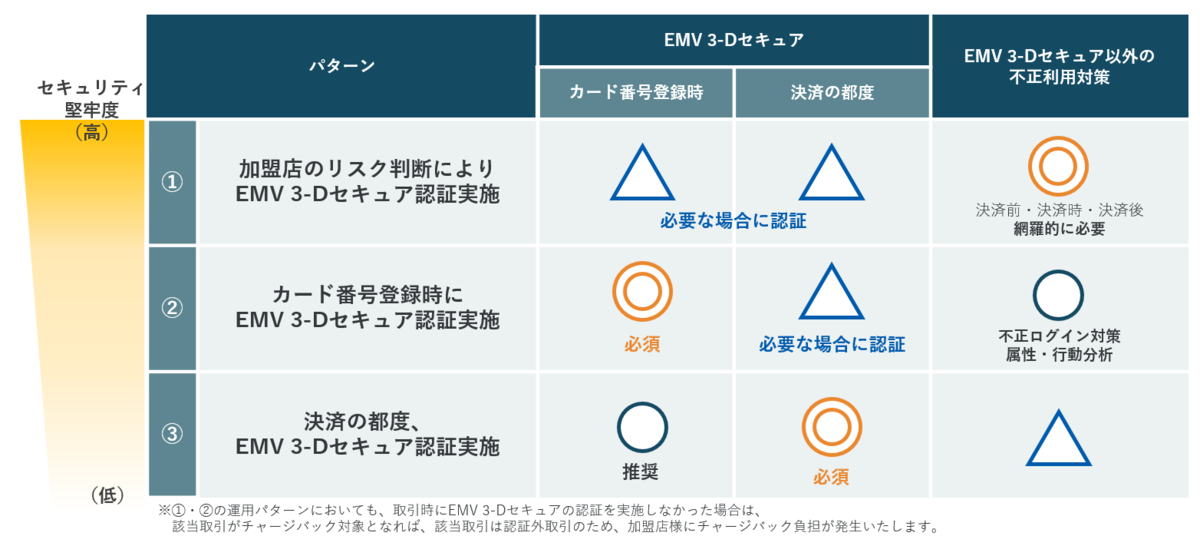
The current 3D Secure presents three operating patterns based on the security measures of merchants. For example, by clearing requirements such as using it with other security solutions, it is easier to reduce genuine user churn due to 3D Secure by allowing 3D Secure authentication only for some suspicious transactions.
3D Secure Operational Patterns
![]()
Step 3. Appropriate induction according to the error reason in the "authorization"
The EC system determines the error code (G-code) and distinguishes the message to be displayed on the user's screen.
Specifically, instead of simply saying "payment failed," you can provide a specific "next action," such as the following statement, to encourage re payment and cover sales on your site.
- For G03 (limit error):"Please use a different card or choose a different payment method "
- In the case of G30 (pending):"It is pending due to the security of the credit card company.
In addition, in the case of recurring billing, the introduction of the "account update" function that automatically updates expired card information is effective.
Summary: payment Funnel Optimization Should Be Done with a Pro
If you unravel the funnel from cart entry to payment completion, you can see that improving the authorization approval rate is not just a system setting or card company factor, but a comprehensive business strategy that mobilizes UI/UX, security design, and error management.
As you read through this article, you may have felt that your site may have unknowingly given up on sales.
"The authorization approval rate in our shop is too low."
"I don't know where the bottleneck is in my payment funnel."
"I'm worried about how much the current 3D Secure operation is affected."
If you feel this way, talk to the professionals at GMO-PG about payment.
We have the largest payment processing data in the country and the know-how to improve payment funnels in all industries. We will reveal the blind spots hidden in your business from the data and propose the best solution to maximize sales.
This is an area where an improvement of just 1% generates significant sales. Let's start with GMO-PG by visualizing the current situation.
Actions that can be taken right now as the first step
If you are wondering what the cart abandonment rate and authorization approval rate are in your company's payment process, first check the difference between the number of carts (sessions) and the number of payment executions (cart abandonment rate) from Google Analytics or the payment management screen. If there are more churns here than expected, or if there is a problem such as "sales dropped after the introduction of 3D Secure", GMO-PG is likely to help. Please contact us using the inquiry form.
Service Introduction
PG Multi-Payment Service
PG Multi-Payment Service is a payment platform provided by GMO Payment Gateway, Inc., a payment processing company company (PSP, Payment Service Provider). It has been introduced to a wide range of businesses, from startups to small ~ large companies, regardless of industry or size.
It provides a solid infrastructure to support a huge payment of 163,890 stores, an annual Transaction value of 21 trillion yen, and 7.22 billion cases processed (*). In addition, it is fully compliant with the global security standard PCI DSS Ver4.0.1, helping any business to create a secure payment environment.
- Supports payment and subscriptions (subscription and recurring payment) each time
- Connection methods are available to suit your needs (OpenAPI type, Link type Plus)
- HDI International Certified Customer Support Department Gate Provides Generous Support
*As of the end of September 2025, consolidated figures

Author
PX+ by GMO Editorial Department
The PX+ by GMO editorial team is a dedicated media team specializing in the payment and Payment Experience (PX, payment experience) area by GMO Payment Gateway.
payment ・Based on the latest trends and practical know-how related to e-commerce operations and cashless in general, as well as examples of growing companies, we compile and supervise practical and reliable information that is useful for business growth.
Click here for the purpose of "PX+ by GMO" and the list of supervisors.