payment Basics
Article published:
"Judgment criteria" that do not fail in EC cart selection. Check out the requirements!


Key points of this article
- Organize the relationship between e-commerce carts and payment
- Understand how to choose by business phase
- Understand what to look for in the payment features you need
- Understand the causes and countermeasures of problems after introduction
INDEX
When launching an e-commerce website, many companies face the challenge of not knowing which e-commerce cart to choose.
The EC cart is not only a mechanism for product registration and order management, but also an important selection item related to the ease of purchase for users and the work efficiency of the operation personnel.Even if it looks like a cart with similar functions, whether it suits your company depends on the business phase and sales method.
In this article, we will sort out the roles of e-commerce carts, explain the differences between each type, how to choose by business phase, and check points for payment functions that are easy to overlook.
If you want to select an e-commerce cart that suits your company's operation based on the basis or if you want to avoid problems after introduction, please refer to the contents of this article.
The role of EC carts
An e-commerce cart is a system that summarizes the functions necessary to sell products on an e-commerce site.
It not only supports the user's shopping experience, but also manages orders, inventory, and delivery on the business side.
First, let's check the role of e-commerce carts.
How EC carts manage order information
An e-commerce cart is a mechanism that mainly manages order information from the time a user selects a product to the time they complete the purchase.
In addition to the ability to add products to the cart, it also has the necessary functions to proceed with the purchase process on the e-commerce site, such as entering buyer information, registering shipping addresses, and confirming order details.
The business operator goes through the order procedure for the EC cart, confirms the order contents, prepares for delivery, and proceeds with subsequent work. Since it is related to the foundation of sales operations, it can be said that it is very important to select an e-commerce cart suitable for your company's operation.
payment is an essential feature for purchasing
On the other hand, you also need a payment mechanic to complete your purchase. Therefore, the e-commerce site will introduce a payment function along with the e-commerce cart.
Whether users can make a smooth purchase depends not only on the ease of use of the e-commerce cart, but also on the payment method it supports.
Therefore, when choosing an e-commerce cart, it is safe to check which payment functions can be introduced while focusing on ease of operation.
Why it is easy to make mistakes in EC cart selection
The main reason for failure in EC cart selection is that it is easy to judge only on items that are easy to understand in the comparison table, such as fees and functions.
In practice, you have to consider payment requirements, sales scale, screening, and fraud prevention.
Here are some typical reasons why discrepancies tend to occur after implementation.
Selection is made only by comparing functions
When comparing e-commerce carts, it is easy to focus on the number of functions, such as the ease of use of the management screen and the presence or absence of promotional functions.
However, if you choose only the number of these functions, it may be difficult to operate after implementation.
It is important to be careful not to judge only the following items.
-
Ease of product registration and inventory management
-
Ease of order processing and shipping settings
-
Abundance of coupons and promotional functions
-
Ease of setting up inventory reservations and displays when out of stock
-
Ease of operation of order status changes and shipment completion notifications
-
Membership information, purchase history, subscription Ease of management of information
These are factors to check, but the actual ease of operation cannot be judged by the features that are easy to compare in appearance.
If you do not check whether the order processing process, linkage with external services, and whether it is compatible with your company's sales methods, you may find it difficult to use after implementation.
payment Putting off requirements
When selecting an e-commerce cart, it's important not to put off the payment requirements. If you choose only because of the ease of product registration and order management, you may not be able to respond to the required payment method, and there is a risk of lost opportunities after implementation.
As shown in the graph below, according to Ministry of Economy, Trade and Industry, the cashless payment ratio in 2024 has risen to 42.8%, with credit cards accounting for 82.9% of the total.
On the other hand, code payment is 9.6%, electronic money is 4.4%, and debit card is 3.1%, and other means other than credit cards are used to some extent.
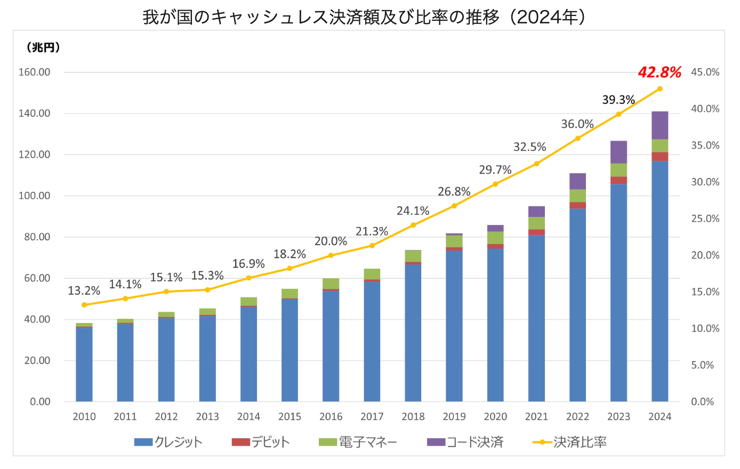
Source: Ministry of Economy, Trade and Industry | Calculated the cashless payment ratio for 2024
Therefore, when selecting an e-commerce cart, it is necessary to check on the premise that credit cards are accepted, and also to sort out in advance whether or not to accept code payment and electronic money depending on your company's customer base and products.
It's important not to just decide on the appearance and management of your site, but also to make sure that it can accommodate the payment method you need and that it will be easy to scale in the future.
Choose without assuming the size of sales
If you choose an e-commerce cart without assuming the size of your sales, you may need to review it as your business grows.
Even if it looks good enough at launch, as the number of orders received and the number of products handled increases, the processing capacity and management functions will be insufficient. For example, if you start with a small-scale configuration, you may not be able to keep up with inventory linkage and order processing when sales promotion measures hit and orders increase.
On the other hand, if you seek excessive functions from the early stages, the cost and operational burden are likely to be heavy.
Choose not only for the initial scale, but also for six months or a year from now.
Not considering risks before the start of sales
When selecting an e-commerce cart, if you judge only by the appearance and ease of use and the number of functions, it is easy to overlook the risks that should be checked before starting sales.
For example, the start of using the payment method requires post-application confirmation and review, and the required documents and the period until the start of use may vary depending on the service provider and product content of the cooperative service.
Even if you're ready to go public, prolonged verification may affect the timing of your release.
It is also important to check in advance to prepare for fraud and chargeback after the sale starts.
When dealing with digital products or high-value products, the risks after the start of operation will depend on whether the identity authentication and fraud detection mechanisms can be supported.
Therefore, it is important to choose an e-commerce cart not only for the speed of introduction, but also for the ease of progress until the start of use and the risk measures after the start of operation.
Types of EC carts and their differences
There are multiple types of e-commerce carts, each with different ease of deployment, scalability, and operational burden. To choose the right e-commerce cart system for your company, it is important to organize the features and precautions before comparing them.
*Features are a general theory of the mechanism and do not necessarily apply to each cart listed
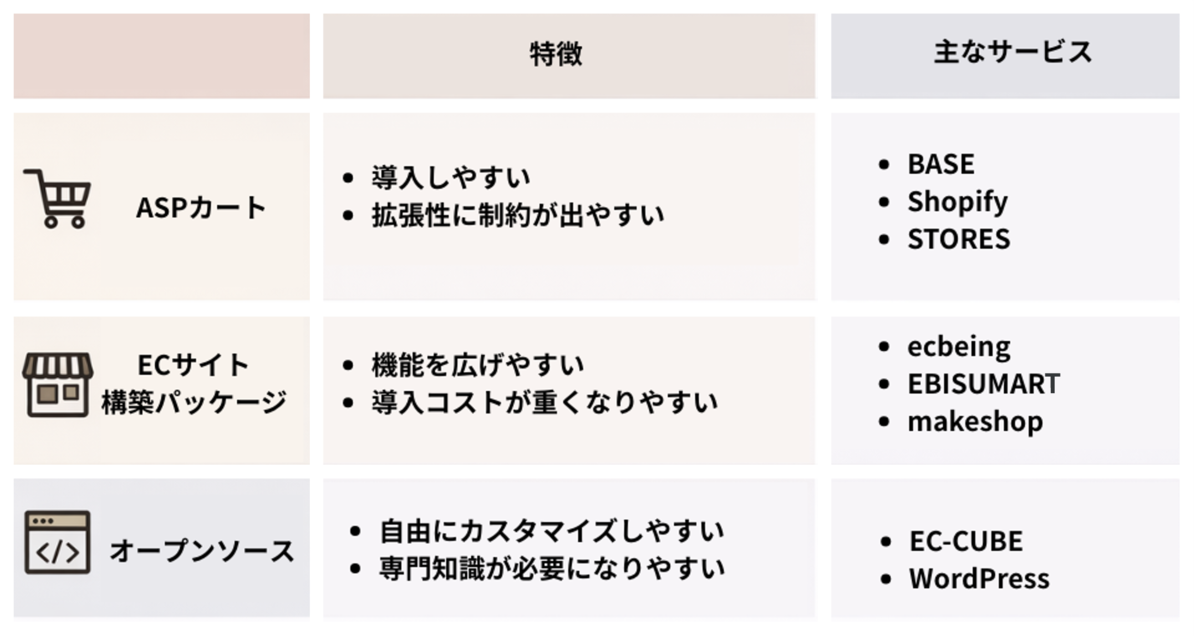
ASP Cart: Easy to launch your own e-commerce in a short period of time
The ASP (Application Service Provider) cart is suitable for businesses that value speed to launch.
This is because the basic functions necessary for shop operation are pre-equipped, making it easy to start selling early.
When starting a new business or a small business, you may want to start selling and verify it. In such cases, this method fits the flow.
On the other hand, as the business grows and requires additional unique features or minor design changes, restrictions may arise.
You should carefully consider whether to prioritize ease of deployment or focus on future scalability.
EC Site Building Package: Feature-rich and highly scalable
The e-commerce website building package is a good choice if you want to choose an e-commerce cart with an eye on business growth.
In addition to basic e-commerce functions, it is easy to proceed with additional development and individual design according to the requirements of each company, such as core system linkage, BtoB support, subscription, and multi-site operation.
ASP also has basic functions, but the packaged type is a method that tends to differ in its ability to respond to unique requirements and flexibility in system integration.
As sales increase, operations tend to become more complex, such as pricing by membership level, inventory linkage across multiple warehouses, reflection of order data in the core system, and coexistence of BtoB and BtoC operations.
In such situations, configurations that can expand functions according to operation come into play.
On the other hand, since the cost and settings at the time of introduction tend to increase, it is important to organize the priority of necessary functions, the scope of cooperation with external systems, whether there is additional development, the target of data migration, the internal operation system, and the budget and schedule in advance.
It is necessary to proceed from the perspective of separating the range that can be handled by standard functions and the range that requires individual response
Open source: low cost and high customization
Open source is recommended if you want to flexibly create it according to your company.
This method may be the best option for e-commerce sites with unavoidable requirements because it is easy to fine-tune functions and design while reducing the fixed costs required for ASP and packaging.
However, in addition to development man-hours and system maintenance management, the burden on the company is likely to increase, and personnel with specialized knowledge and partner companies are required, so it is important to consider the operation system after the system is introduced.
[Comparison by business phase] Points to look at when start-up, growth, and expansion
EC carts have different points to look at depending on the business phase. This is because each phase changes the features and system requirements that should be prioritized.
As shown in the figure below, if you organize what stage your company is at now, it will be easier to make a selection without excess or deficiency.
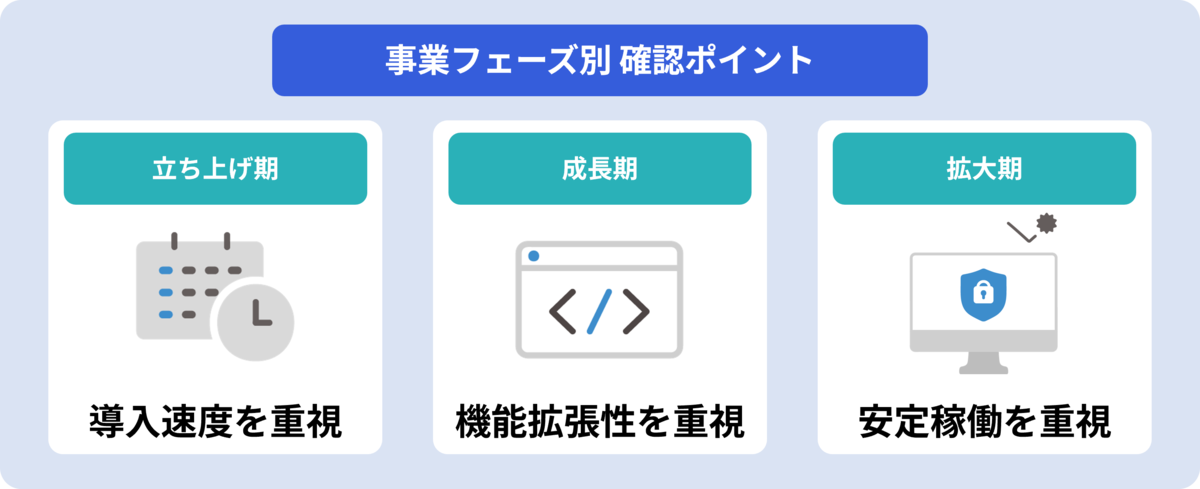
Startup: Focus on speed of adoption
During the launch period, it is important to prepare the conditions to start selling as soon as possible.
Rather than asking for features too widely, it is easier to prevent initial delays if they are easy to publish in a short period of time or to proceed from application to use.
In new businesses, sales forecasts and operational systems have not yet been finalized, so it is essential to start up and verify them first.
Therefore, in addition to the initial cost and speed of implementation, it is important to check whether it is easy to prepare the necessary documents, whether the partners are organized, and whether the flow to start using the service is easy to understand.
Growth period: Emphasis on scalability
As we enter the growth period, it is important to be able to expand the functions of e-commerce as sales channels and customer bases expand. At the stage of strengthening sales promotion measures and repeat purchases, it will be easier to operate if it is easy to link with external systems such as CRM, MA, inventory management systems, and order management systems.
Another important point is whether you can increase the payment method. Even if credit cards were good at launch, as the number of users increased, there would be more situations where it was required to respond to career payment, ID payment, buy now pay later payment, etc.
During the growth period, you need to look not only at the functional requirements you need now, but also at whether you can expand later.
Expansion period: Emphasis on stable operation
During the expansion period, a system that can not only increase sales but also continue to operate stably is required.
As the number of transactions increases, the impact of chargeback by fraud and attacks such as mass attacks increase, so it is also important to create a defensive system to prevent business from being stopped. Therefore, it is necessary to check the identity authentication and fraud detection mechanisms, as well as the stability that is difficult to stop even when access is concentrated.
Even if you are conducting advertising measures or large-scale campaigns, it is also important to make decisions whether you can withstand the load.
payment Points to check for functions
When choosing an e-commerce cart, you should look not only at the ease of use of the screen but also at the payment features.
The reason is that depending on payment method, authentication settings, and payment conditions, sales will be missed and the operational burden will change.
To prevent problems after implementation, it is important to organize "which payment can be used" and "whether it can be operated safely" at the pre-sales stage.
Credit card payment Supported brands
Credit card payment requires verification of supported brands.
Credit cards are payment method that are easy to use in e-commerce, so if they are not compatible with major brands, it is easy to miss out on purchase opportunities.
Check out international brands such as:
-
Visa
-
Mastercard
-
JCB
-
American Express
-
Diners Club
It's important to make sure you have a brand that fits your sales target, rather than just the number of supported brands.
For example, if domestic sales are the main focus, it is necessary to look at brands that are easy to use for domestic users, and if cross-border e-commerce is assumed, it is necessary to include brands that are easy to use for overseas users.
In addition, if the application process and start date of use are shifted for each brand, only some brands may be available first, so be sure to check in advance to see if it will affect the timing of the start of sales.
Identity payment and E-wallet Availability
In addition to credit cards, you should also check if they support ID payment and E-wallet.
The reason is that different users prefer different payment methods, and fewer options can lead to abandonment mid-purchase.
For example, when it comes to smartphone purchases, payment method tends to be more likely to be chosen because it requires less input.
Typical examples include:
-
PayPay
-
Rakuten Pay
-
Amazon Pay
-
Apple Pay
-
Google Pay
Determining how much you need according to your company's products and customer base will lead to a design that does not miss sales.
EMV 3-D secure support
EMV 3-D secure support is important for Credit card payment safety.
Since face-to-face verification is not possible in e-commerce, weak authentication settings can lead to damage and chargeback due to spoofing.
On the other hand, depending on the setup method, it may increase the buyer's effort and cause churn.
Therefore, it is necessary to check not only whether it is supported, but also the ease of introduction and the impact on the purchase experience.
Fraud Detection and chargeback Measures
Fraud detection and chargeback protection are features you should look for to protect your sales.
Especially when dealing with high-value products or digital products, the impact of damage is greater.
Before implementation, it is easier to make a decision by looking at the following points:
-
Can you automatically detect fraudulent orders?
-
Is there a mechanism to check for suspicious transactions?
-
chargeback Is the scope of response clear in the event of an outbreak?
-
What kind of confirmation work is necessary for the company?
It is important not to decide only on the speed of introduction, but to choose with an eye on continuous operation.
Deposit cycle and cash flow
The deposit cycle is a confirmation item that is easy to overlook but has a significant impact on operations.
Even if sales occur, they may not be deposited immediately, so depending on the conditions, it will put a burden on cash flow.
For example, in a business where advertising expenses and purchasing payment come first, cash flow is likely to be unstable if the time until payment is long.
What you should also check is the transfer fee and the minimum transfer amount conditions.
Not only the commission rate, but also looking at when it can actually be funded, will lead to reasonable management.
Problems that often occur after introducing EC carts
EC carts are not the end of the introduction, and unexpected problems may occur after the start of operation.
Here, we will sort out the problems that often occur after introducing an e-commerce cart.
fraud and chargeback occur
One of the problems that are likely to occur after the start of operation is the occurrence of fraud and chargeback.
chargeback is when a customer appeals to the card company and the sale is reversed. Not only fraud, but it can also occur due to misunderstandings of purchases or misunderstandings in refund responses.
As the number of cases increases, not only does sales decrease, but the burden of verification work and submission of evidence tends to be heavy. In particular, when dealing with digital products or high-value products, it is easy to be affected, so it is essential to check the identity authentication and fraud detection mechanisms in advance.
payment method Lack increases churn
Lack of payment method will cause them to drop off mid-purchase.
Even if they are interested in a product, many users will stop buying it on the spot if they do not have the desired payment method.
Credit cards alone can be missed, and some customers may need to support ID payment or E-wallet.
In particular, when purchasing from a smartphone, payment method tends to be the one that requires less input. When selecting an e-commerce cart, you need to make sure that it has a payment configuration that is easy for your customers to use, not just a large number of features.
Delayed deposits worsen cash flow
Even if sales occur, if it takes a long time to receive payments, it may affect cash flow.
In e-commerce, payment such as advertising costs, purchasing, and shipping costs often come first, and long deposit cycles can easily lead to a shortage of cash on hand. In particular, immediately after launch and when sales promotion is strengthened, it is important to control not only the amount of sales, but also when it will be paid.
In addition, depending on the transfer fee and the conditions of the minimum transfer amount, the funding may be delayed than expected.
Don't judge only by the commission rate, but check the deposit conditions.
[By business] Checklist for EC Cart Selection
It is important to organize the items to be checked according to your company's Business Overview, rather than choosing an EC cart based solely on the number of functions.
If you look at the four points of product, sales scale, risk, and ease of operation first, it will be easier to prevent deviations after implementation.
First, let's align the axes of judgment with the following checklist.
| Check items |
Check contents |
Confirm |
|
Products for sale |
Are you able to organize the payment method that suits your product? |
□ |
|
Estimated sales |
Are you expecting a processing capacity that matches the number of orders received and the scale of sales? |
□ |
|
Risks |
Have you decided on a plan for fraud or chargeback? |
□ |
|
Operability |
Is it easy to handle refund and cancellations? |
□ |
Determine the payment method you need from your products
The first thing you want to check is whether you can choose a payment method that matches the product you are selling.
In product sales and digital products, the payment methods that users want and what to pay attention to when operating them will change.
For example, products with higher unit prices tend to value Credit card payment convenience, while products that cater to younger demographics tend to choose ID payment and E-wallet.
The functionality required will change with or without recurring payment, so it is essential to organize payment according to the characteristics of your product.
A payment design that fits the selling style is the foundation for preventing churn.
Determine the required payment processing capacity from expected sales
EC carts should be selected not only with current sales but also with an eye on future orders. This is because even if it looks good enough at launch, as the number of orders increases, there is a difference in processing speed and ease of order management.
When sales promotion measures are successful and orders are concentrated, if payment processing and inventory linkage cannot keep up, it will lead to lost sales opportunities. On the other hand, excessive configuration from the early stages tends to increase costs and administrative burdens. Determining the processing capacity that fits the expected sales will lead to reasonable operation.
Considering various risks and taking measures against fraud
Anti-fraud measures are an item that should be considered for necessary measures depending on the product and sales method. This is because the higher the transaction risk, the more susceptible it is to fraud and chargeback.
Digital goods and high-value products are often provided immediately after purchase, and they tend to be difficult to recover when damage occurs.
Therefore, it is necessary to first organize how far you should be prepared, such as identity authentication, 3D Secure, and fraud detection.
Check if it's easy to handle refund and cancellations
When choosing an e-commerce cart, you need to check not only the flow of sales, but also whether it is easy to proceed with refund and cancellations.
After the sale, cancellations or changes may occur due to the convenience of the buyer, and if the processing is complicated each time, the burden on the person in charge is likely to increase. For example, whether it is easy to operate refund and cancel on the management screen, or whether you can check order information and payment data at once, will change your daily operations.
Before introducing, it is essential to see if it is easy to use, including not only the functions for selling, but also the after-sales correspondence.
Summary: Organizing business phases and payment requirements can reduce the risk of selection failure
In order to prevent failure in EC cart selection, it is important to determine whether the configuration is suitable for your company's business phase, rather than judging only by the number of functions.
It is easier to prevent deviations after introduction by checking the ease of introduction during the launch period, the ease of payment method expansion during the growth period, and the anti-fraud measures and stable operation during the expansion period.
If you would like to consider including the payment requirements, please contact our payment processing company company (PSP) "GMO Payment Gateway".
Our "PG Multi-Payment Service" is a comprehensive payment service that allows you to deploy various payment method such as Credit card payment, CVS Payment, recurring payment, etc. at once.
We can introduce a wide range of carts connected to our payment, so please contact us below.
Service Introduction
PG Multi-Payment Service
PG Multi-Payment Service is a payment platform provided by GMO Payment Gateway, Inc., a payment processing company company (PSP, Payment Service Provider). It has been introduced to a wide range of businesses, from startups to small ~ large companies, regardless of industry or size.
It provides a solid infrastructure to support a huge payment of 163,890 stores, an annual Transaction value of 21 trillion yen, and 7.22 billion cases processed (*). In addition, it is fully compliant with the global security standard PCI DSS Ver4.0.1, helping any business to create a secure payment environment.
- Supports payment and subscriptions (subscription and recurring payment) each time
- Connection methods are available to suit your needs (OpenAPI type, Link type Plus)
- HDI International Certified Customer Support Department Gate Provides Generous Support
*As of the end of September 2025, consolidated figures

Author
PX+ by GMO Editorial Department
The PX+ by GMO editorial team is a dedicated media team specializing in the payment and Payment Experience (PX, payment experience) area by GMO Payment Gateway.
payment ・Based on the latest trends and practical know-how related to e-commerce operations and cashless in general, as well as examples of growing companies, we compile and supervise practical and reliable information that is useful for business growth.
Click here for the purpose of "PX+ by GMO" and the list of supervisors.