payment Basics
Article published:
Profits are coming out but "passbook balance" is insufficient - a strategy to extend the payment of 3% commission to prevent the construction industry from going bankrupt


Key points of this article
- Explain the risk of surplus bankruptcy due to "delayed payment" unique to the construction industry and its structural causes.
- Organize issues with existing methods such as loan review periods and factoring costs.
- BPSP (Invoice Card Pay byGMO) is a third funding vehicle that can extend payment for up to 60 days with a fee of 3.0%.
INDEX
For a short time, I thought, "I got a big deal this month, and this is a relief," but the more the site moved, the more "advance cash" such as material costs, outsourcing costs, and heavy machinery leasing costs mercilessly cut down on the account...
If you are a business owner involved in the construction industry, you may have experienced this feeling at least once. Orders are going well and profits are coming out. However, due to the misalignment of the payment cycle, cash flow is difficult - this is a structural problem faced by the construction industry.
In addition to the payment of the cost of materials to move the site, the Construction Business Act sets strict deadlines for the payment of payments to subcontractors (subcontractors).
If the prime contractor receives a payment of the construction price (piecework payment, completion buy now pay later) from the client, the prime contractor is obliged to pay the subcontractor within one month from that date (Article 24-3, Paragraph 1 of the Construction Business Act).
In addition to this, if you become a specified construction company (a prime contractor who undertakes large-scale construction), even stricter rules will be added. There is an obligation to pay within 50 days from the date of delivery from the subcontractor (Article 24-6, Paragraph 1 of the same law), which applies regardless of the status of payment to the main contractor.
On the other hand, it is not uncommon for the payment to be made to the main contractor after the completion of the construction and the next month after the acceptance inspection.
This double legal obligation that occurs between the "waiting for payment" and the "payment deadline" is the structural issue that constantly puts construction industry managers under pressure on cash flow.
In this article, we will explain the mechanism of BPSP (Business Payments Solution Provider, invoice Card Payment), which is attracting attention as a "third option" after lending and factoring, and how it can be used in the construction industry.
The identity of the "money gap" that erodes the construction industry - why is the passbook empty even though there is a job?
Number of bankruptcies in the construction industry
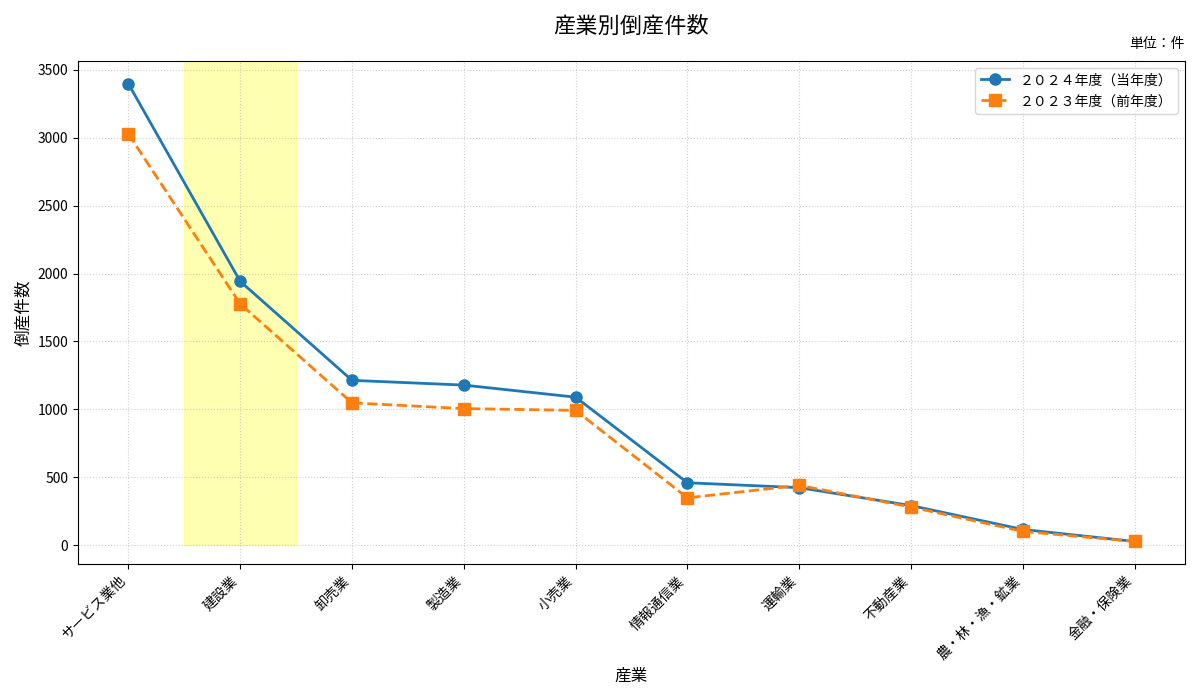
Reference: [National Corporate Bankruptcies | Tokyo Shoko Research] (https://www.tsr-net.co.jp/news/status/detail/1201244_1610.html)
According to a survey by Tokyo Shoko Research, the number of bankruptcies in the construction industry ranks high among all industries.
"The site is moving, the craftsmen are all there, but there is not enough cash to pay next week's salary and outsourcing costs."
This lonely fear is not born from the lack of ability of managers, but from the "structural issues" faced by the construction industry.
Structural risks caused by "3-month delay in payment"
Let's look at an example of a money flow.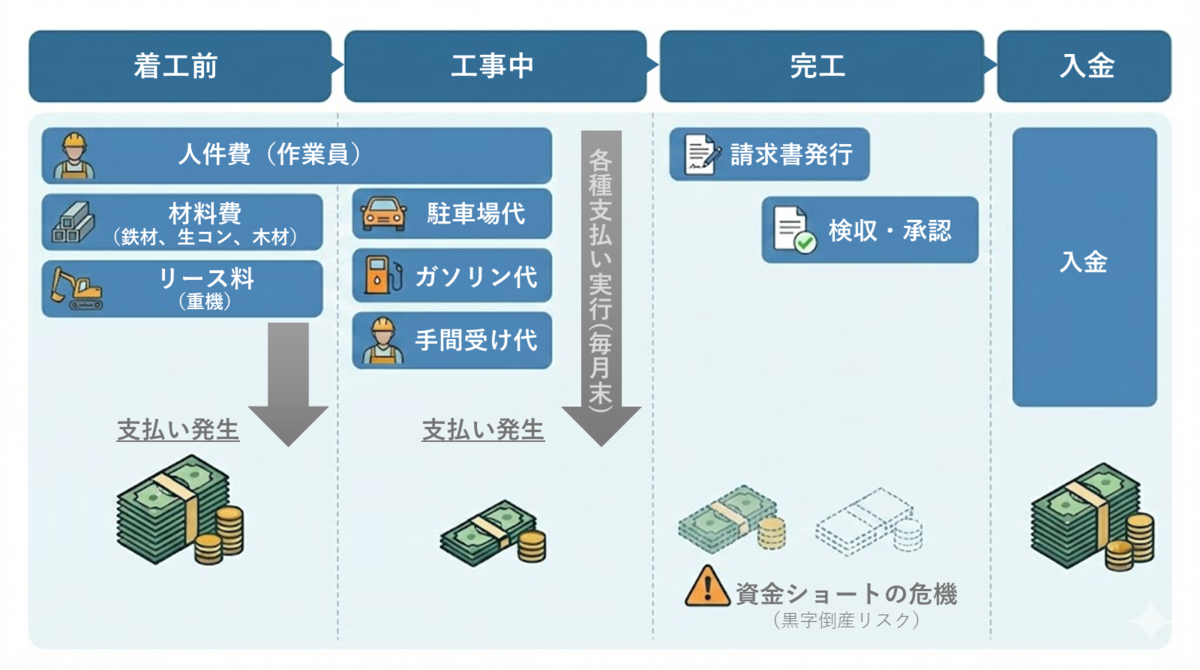
[payment Phase ]
・Before the start of construction (before the start of construction): "material costs" such as steel, ready-mixed concrete, wood, etc., and "lease fees" for heavy machinery are paid in advance.
・During construction: "parking fee" around the site, "gasoline fee" for construction vehicles, and "labor fee" for single parents
*End of the month: Execution of payment to partner companies
[Deposit phase]
・Completion (construction completed): Issued invoice to the main contractor
→ Acceptance and Approval Process
→ finally made a deposit
In other words, there is a time lag of about 3 months between the occurrence of cash-out such as material costs and the receipt of payment from the main contractor. If the next project overlaps during this period, the required working capital will snowball.
For example, a construction shop with annual sales of 500 million yen may need working capital of 100 million yen due to the overlap of multiple sites. If we cannot provide this fund, it will be difficult to continue the business no matter how many orders we receive.
payment pressure created by subcontracting structures
What is even more serious is the multi-layered structure of prime contractor, subcontractor, and subcontractor. Even if the payment from the prime contractor is delayed, the payment from the company to the partner company will not wait. Even if there is a guarantee that the payment will be made from a major general contractor in two months, if you do not pay the outsourcing fee at the end of this month now, you will not be able to get cooperation at the next site.
This dilemma of "payment cannot wait, payment is slow" is structurally putting pressure on the cash flow of the construction industry.
Why financing and factoring alone cannot solve the problem
As a means of improving cash flow, many companies are considering loans and factoring from financial institution banks and other institutions. However, each has its own "ease of use" unique to the construction industry.
|
Compare items |
Bank Financing |
Factoring (GMO B2B Early Payment) |
BPSP |
|
1. Fees (quotes) |
Low (about 1-3% annual interest rate + guarantee fee, etc.) |
High (around 10%) |
Low (3.0%) |
|
2. Screening (Availability and Period) |
Yes (review of company/financial results) Usually a few weeks to one month |
Yes (mainly for the examination of accounts receivable) The shortest day to a few days |
Yes (own simplified screening) Earliest same day ~ next business day * Depends on the application time |
|
3. Speed (fundraising) |
Late (weeks to 1 month) Sudden payment may not be in time |
Instantly cash out accounts receivable as soon as possible (same day to days) |
Early (minimum same-day review, in principle completed on the next business day) payment extended by up to 60 days |
|
4. Impact on Business Partners (Risk) |
None (transaction with banks) |
None (available without the knowledge of the business partner) *The fee will be higher. |
None (You can set the transfer holder as your company name) |
|
5. Impact on bank borrowing facilities (retention/consumption) |
(Not suitable for those who want to preserve the quota for large investments to consume) |
Preserve (Not borrowing for the sale of accounts receivable) |
Preserve Used to adjust the time lag of daily cash flow |
The Challenges of Bank Financing: Speed and Flexibility
The biggest problem with bank loans is the examination period. It usually takes a few weeks at the earliest from applying for working capital to execution. It is not realistic to make it in time for "next week's payment".
In addition, there are restrictions on the borrowing limit for loans. In addition to existing borrowings, there are many cases where it is not possible to meet urgent financial needs (such as large investments) because upper limits such as "up to what percentage of annual sales" and "within the range of collateral valuation" are set.
In addition, depending on the financial results and performance trends, it may not pass the examination. It is especially difficult if the company has just been established or if there is a period of temporary loss.
And we must not forget the perspective of "preservation of the borrowing line (credit line)". If you use bank loans to fill the temporary gap of daily deposit lags, you may run out of space in the event of a large investment (replacement of vehicles, opening a base, etc.) in an emergency. Daily discrepancies are washed away by BPSP (invoice card payment), and the relationship of trust with the bank is left for "aggressive" investment. This is a smart way to fight construction management.
Factoring Challenges: High Costs and Consideration for Suppliers
Factoring is a mechanism that "sells accounts receivable and immediately capitalizes" and is superior in terms of speed. However, the high fee is a bottleneck.
In the case of factoring between two companies, the fee is high at around 10%.
If you fund a accounts receivable of 10 million yen, you will have 9 million yen on hand. For the construction industry, which has a profit margin (ordinary profit margin on sales) of about 5%, this fee burden directly hits management.
In addition, using factoring between three companies (a method of notifying the transfer of receivables in advance payment) reduces fees but raises the risk of deteriorating relationships with business partners. "Is that company having trouble with cash flow?" If you have a concern, there is a possibility that it will affect your next order.
Why BPSP (invoice Card Payment) Will Change the Cash Flow of the Construction Industry
In light of these challenges with existing methods, BPSP, the so-called "invoice card payment" service, has been attracting attention in recent years.
How does payment extend for up to 60 days?
The basic mechanism of BPSP (invoice Card Payment) is simple. Essentially, you payment the amount of invoice you should pay with Bank transfer with your credit card.
For example, in "Invoice Card Pay byGMO", it is used as follows:
- Membership Registration
- Enter the contents of the invoice received from the business partner into the system
- Run payment with a credit card
In these three steps, the GMO Payment Gateway will transfer money to the account's account in the name of the company you are using.
At this time, you can use the credit card closing and payment date cycle to postpone the actual direct debit by up to 60 days.
[Specific example] In the case of a card that closes at the end of the month and pays on the 2nd of the following month
・April 1: Receive invoice, execute card payment → transfer to business partner
・April 30: Card closing date
・June 2: Withdrawal from your own account
This means that the business partner can complete the payment immediately, while the company's outflow of funds will be deferred until about two months later.
Clear fee structure with a flat rate of 3.0%
The commission for "Invoice Card Pay byGMO" is a flat 3.0% (minimum fee of 1,500 yen per trade). Compared to the factoring fee level of 10%, the cost benefits are obvious.
Specific example: When paying an outsourcing fee of 1 million yen:
・Factoring: Fee 100,000 yen
・ invoice Card payment: 30,000 yen fee
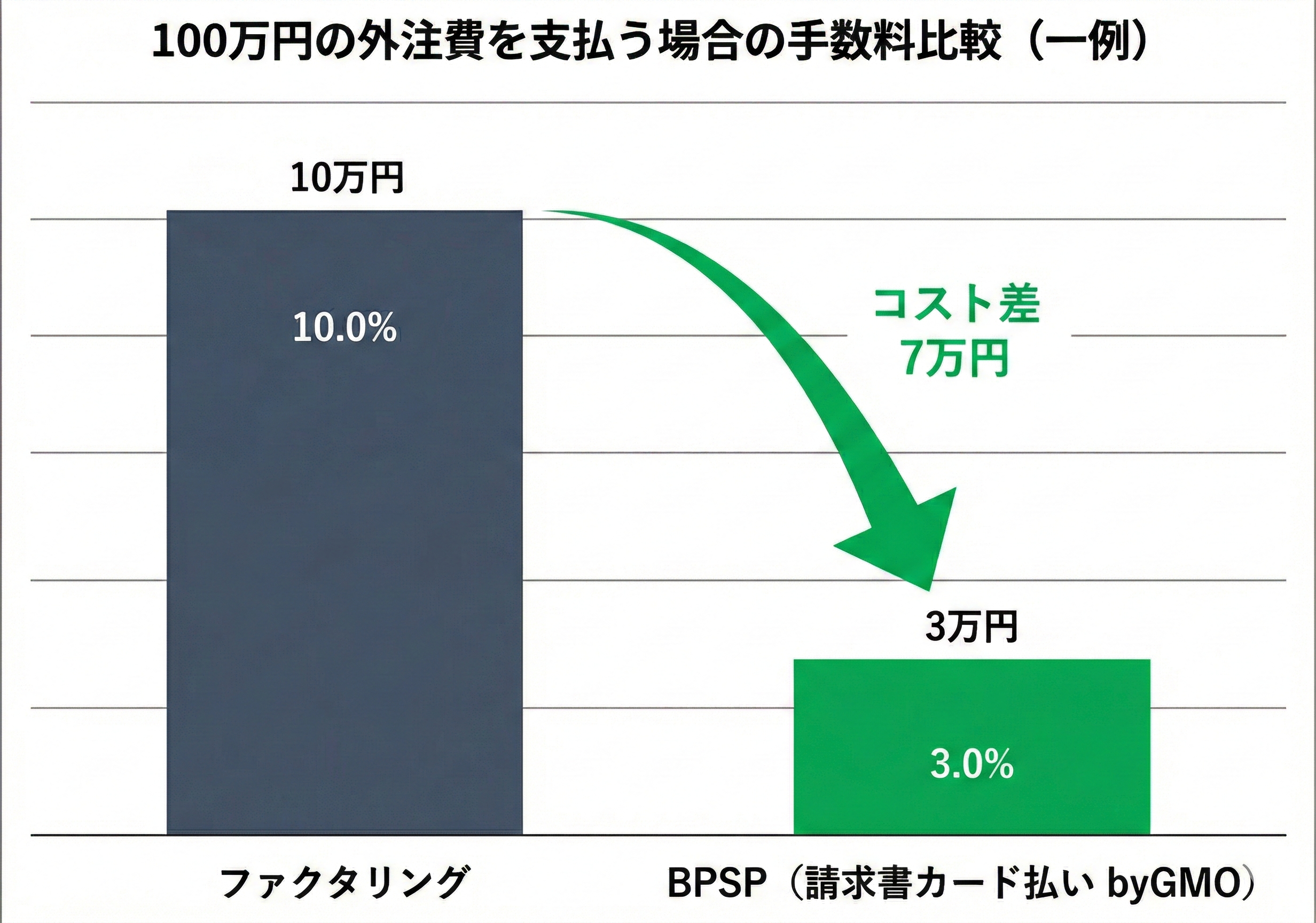
In terms of years, this difference has a significant impact on management.
*Credit card limit and availability vary depending on factoring review
Also, unlike bank loans, it is only available for simplified screening. The first payment is available in three steps (membership registration, invoice information entry, card registration) in the shortest possible hours.
Usage of BPSP (invoice Card Payment) in the Construction Industry
Case 1: Elimination of "fund gap" due to unexpected extension of the construction period
In a large-scale project, it was confirmed that the payment from the main contractor would be delayed by one month from the original plan due to the extension of the construction period. However, we cannot postpone the payment of the outsourcing cost of 3 million yen to a partner company at the end of the month. We switched some of the outsourcing costs (e.g., 1.5 million yen) that were insufficient with cash on hand to BPSP (invoice card payment).
This allows you to extend the timing of cash-out by up to 60 days, eliminating the funding gap caused by delays in deposit timing. While preserving the bank loan line, we were able to maintain a relationship of trust with our partner companies even in unforeseen situations and avoid short-selling funds.
Case 2: Breaking through the "month-end wall" due to payment of concentrated outsourcing costs at multiple sites
Three sites were carried out at the same time, and payment of the total outsourcing costs of 12 million yen were concentrated at the end of the month. The cash on hand was 6 million yen, and at the end of the month, payment was 6 million yen short. I switched the shortfall of 6 million yen to BPSP (invoice card payment) to avoid payment delays.
This allowed me to extend my payment by up to 60 days, and there were deposits from other projects between the time when the card was debited, and I was able to overcome the wall at the end of the month without a shortage of funds. This is an example of preserving bank loan lines by using BPSP (invoice card payment) as a time lag adjustment for daily cash flow.
BPSP (invoice Card Payment) can be used without the business partner knowing.
When considering BPSP (invoice card payment), many business owners are concerned about whether their business partners will know that they are paying by card. This concern is especially urgent in the construction industry, as credit is directly linked to orders.
Safe design that allows you to transfer money in your own name
With "Invoice Card Pay byGMO", you can freely set the transfer holder. In other words, the company's company name is printed on the business partner's passbook instead of "GMO Payment Gateway".
From the perspective of the business partner, it only looks like it was transferred from the company as usual. You can improve your cash flow without being told that you are using the card payment service at that company, and you can maintain the same relationship of trust as before.
This function is important in the construction industry, where the prime contractor and subcontractor relationship continues for a long time. It allows for greater financial strategy freedom without compromising relationships with partner companies.
In the construction industry, horizontal connections and trust are key. As a business owner, you must avoid being rumored by a partner company that "it seems that they paid with a credit card payment because they are having a hard time with cash flow there."
In that respect, BPSP (invoice card payment) allows you to freely set the transfer holder, so only your company's name will be printed on the other party's passbook as usual. It is possible to strengthen the financial system without damaging the relationship of trust with the craftsmen and partner companies who support the site. This feature is one of the reasons why BPSP (invoice Card Payment) is chosen in the construction industry.
The transfer procedure is also handled by GMO Payment Gateway
In addition, the actual transfer procedure is also handled by GMO Payment Gateway. All you need to do is enter invoice information into the system and run the card payment. There is no transfer fee, which also leads to more efficient accounting operations.
payment to multiple business partners can be payment by card at once and transferred to each account in their own name - this system can also be expected to reduce the burden on accountants.
GMO Payment Gateway Reliability – Peace of Mind Provided by Listed Companies
Because it is a service related to the lifeblood of a company, which is cash flow, the reliability of the provider is important.
GMO Payment Gateway is a TSE payment processing company company listed on the Prime Market. There are Actual that have supported a wide range of infrastructure of payments, including major e-commerce sites in Japan and CVS Payment and QR code payment.
"Invoice Card Pay byGMO" supports Visa/Mastercard issued in Japan. If you already have a corporate card, you can use it as it is.
The strict security standards unique to listed companies and the know-how cultivated over many years of payment processing business support the stability of the service.
Aggressive financing strategies that you can start today
BPSP (invoice Card Payment) is an emergency evacuation plan and a strategic tool
Some of you may have read this far and thought it was a "last resort when you are in trouble with cash". However, the true value of BPSP (invoice Card Payment) lies in its strategic utilization.
Whether you view the 3.0% fee as a "cost" or an "investment" is important in this perspective.
For example,
・Strengthening relationships with suppliers through early payment (there is a possibility that there will be room for discount negotiations)
・Improving responsiveness to new projects by preserving cash on hand
・Preserving bank loan lines (preparing for large-scale investment opportunities)
Considering these strategic benefits, the 3.0% fee can be considered a benefit-generating investment.
Take advantage of low introduction hurdles
・Simplified screening: Only your own simplified screening can be used within the card limit.
・Online concise: Online only, in principle, start using the same day in 3 steps
・No maintenance fee: Flexibility to use only when you want to use it without monthly maintenance fees
This ease of use makes BPSP (invoice card payment) a "must-have". It is worth it because it is only registered in case of emergency and uses it when necessary.
Use with other financing methods is key
BPSP (invoice Card Payment) is not a replacement for bank lending or factoring, but a combination of them.
・Financing for each project and long-term capital investment: Bank loans
・Sudden large-scale projects: factoring
・Adjustment of daily working capital deviation: BPSP (invoice card payment
By using them differently, you can complement each other's weaknesses and build a more resilient financial structure.
Summary: From "waiting for payment" to "aggressive management"
The financing problem of the construction industry has been talked about as if it were a fate rooted in the industry structure. However, with the advent of a new tool called BPSP (invoice Card Payment), the approach to this problem has diversified.
Features of "Invoice Card Pay byGMO"
• Extend payment by up to 60 days to improve cash flow
・The fee is a flat rate of 3.0% (minimum fee of 1,500 yen)
・Completed online with only a simple examination, available on the same day
・You can set the transfer holder as your company name and it will not be known to your business partners.
・Reliability of GMO payment gateways for listed companies
From a situation where you have a job but are pressed for cash, you can go to management with plenty of cash on hand and seize the next growth opportunity. To help with this, there is an option called BPSP (invoice Card Payment).
Why not start by registering and having it as a "talisman" in case of emergency?
Service Introduction
Invoice Card Pay byGMO
"Invoice Card Pay byGMO" is a BPSP service provided by GMO Payment Gateway that allows you to convert Bank transfer designated invoice to credit card payment.
[Features of Invoice Card Pay byGMO
- payment to Card payment
Regardless of the seller's designation, card payment is possible at the buyer's discretion. - cash flow improvement without borrowing
There is no financing process, and the payment due date can be postponed up to about 60 days later. - Lowest fees in the industry
Low-cost fee settings support continued use.
*There is a prescribed review for use. Also, the extension period depends on the payment day and the date the card is debited.

Author
PX+ by GMO Editorial Department
The PX+ by GMO editorial team is a dedicated media team specializing in the payment and Payment Experience (PX, payment experience) area by GMO Payment Gateway.
payment ・Based on the latest trends and practical know-how related to e-commerce operations and cashless in general, as well as examples of growing companies, we compile and supervise practical and reliable information that is useful for business growth.
Click here for the purpose of "PX+ by GMO" and the list of supervisors.