決済基礎知識
Article published:
"invoice card payment" to survive the "purchase advance" of the retail industry. Financial strategies to extend payment such as inventory and advertising spend by up to 60 days
Key points of this article
- Eliminate the funding gap: By using invoice card payments, you can push back payment of purchases and rent until the card company's debit date.
- You can pay to your business partner with Bank transfer: The name of the transfer can be set to your own name, and it is designed to be used without informing your business partner of the use of this service.
- Need to check the constraints before implementation: There are costs and vetting when using it, so it's important to check beforehand.
INDEX
"New products in the fall and winter are selling well, but when the payment day to the supplier approaches, the account balance is not worrying. Even though it is selling, it is not possible to place additional orders or place advertisements.」
For retail business owners and accountants, this kind of monthly "dealing with the discrepancy between payment and payment" is a chronic management issue.
In the retail industry, payment such as purchase prices, online advertisement expenses, and store rent tend to occur first, while sales proceeds for Credit card payment and QR code payment are deposited at a later date, so there is a tendency for there to be a discrepancy in cash on hand. In particular, during periods when bulk purchases and additional orders for hot-selling products overlap before the sales season, it is easy to fall into a situation where "there is not enough cash even though it is selling".
One of the measures to address this funding gap is "invoice card payment", which switches the invoice specified by the Bank transfer to Credit card payment. Among them, "Invoice Card Pay byGMO" can defer the payment due date up to about 60 days later, making it easier to adjust cashouts according to the timing of sales receipts. In this article, we will explain how this system can be useful in the retail industry, along with suitable cases and precautions.
"Mismatch between deposit and payment" that is likely to occur in the retail industry in the cashless era
A long time ago, you could receive cash at the store and use that cash to make the next purchase. But now, cashless payment is also dominant in stores, and sales are less likely to be in place immediately.
Against this background, cash flow tends to be tight, especially in the following cases.
Bulk purchase for seasonal sales: Especially in the case of apparel and miscellaneous goods, it is necessary to secure millions of yen in inventory for seasonal sales, bonus sales, year-end sales, etc.
Sudden increase in demand: Specific products have started to sell rapidly due to the influence of social media, etc., and I want to place additional orders with the manufacturer right now, but the sales for the previous month have not yet been received.
payment overlap with fixed costs: In the same month as purchases, payment such as online advertisement expenses, store rent, and mall-related expenses also overlap, and the cash balance is diluted at once.
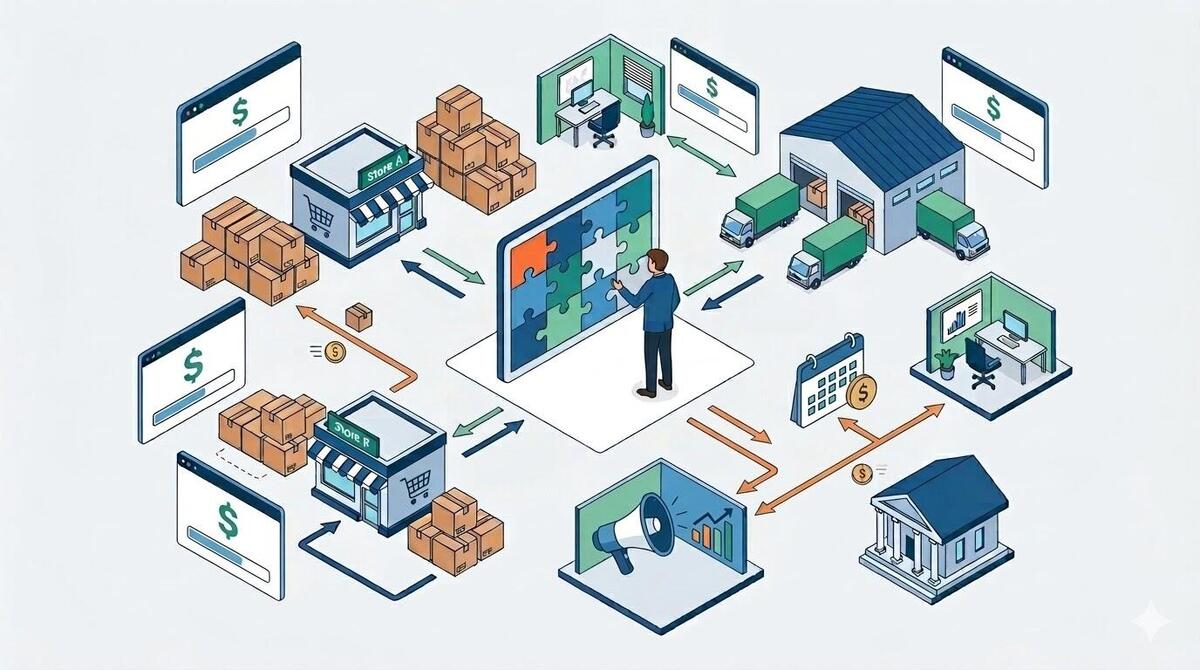
Particularly difficult are medium-sized businesses that are promoting multi-store development or operating e-commerce and physical stores in parallel. While waiting for store A to receive sales, cash flow adjustments such as purchasing autumn and winter goods inventory at store B and paying advertising costs for e-commerce sites occur on a daily basis, and managers put a lot of effort into cash flow management.
Bank loans are also a financing option, but there are situations where you want to have a more flexible means in situations where you need it right now, such as purchasing before a sales season or placing sudden additional orders. In the retail industry, it is important to be able to respond to the cash gap where there are sales but there is a temporary shortage of cash on hand.
How to adjust payment timing while protecting your relationship with your business partner
In such a situation, it is easy to consider a service that switches the invoice specified by Bank transfer to Credit card payment. The "Invoice Card Pay byGMO" provided by GMO Payment Gateway (hereinafter referred to as GMO-PG) is one of them.
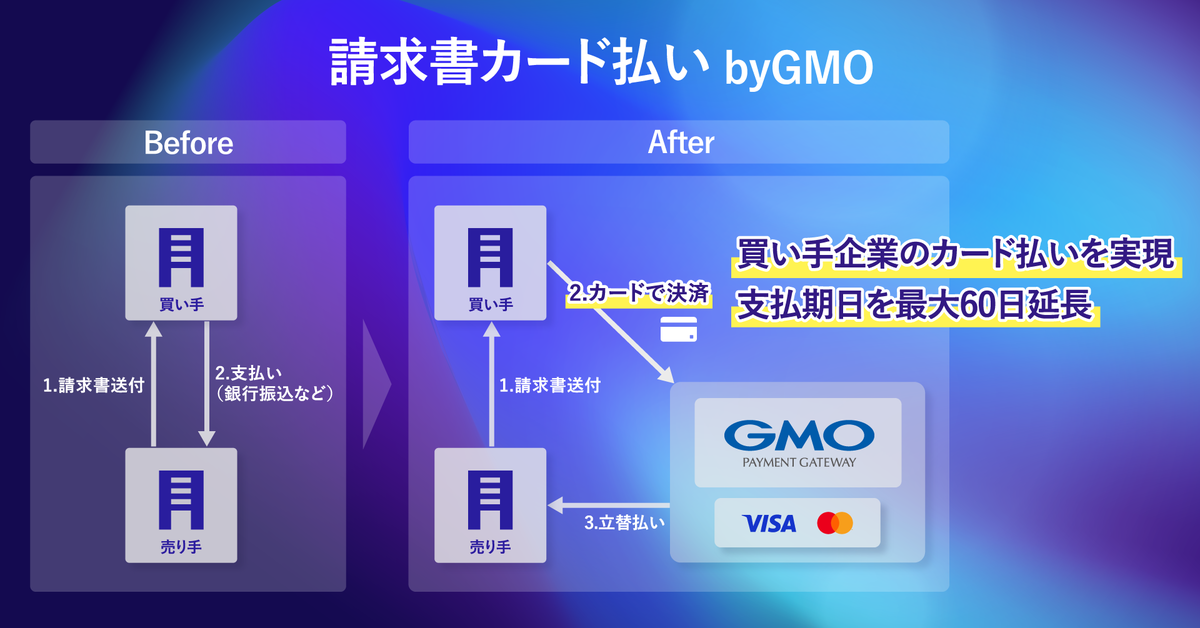
The mechanism is simple, and payment to business partners is done on Bank transfer, making it easy to use without significantly changing the transaction flow so far.
[Invoice Card Pay byGMO mechanism and benefits
The company payment with a card:register the received invoice information online and apply for a credit card payment.
Deposit to the business partner with Bank transfer: GMO-PG will make a cash transfer to the bank account of the payee in your name at the earliest.
Push your actual spending back: The actual debit from your own account will be on the payment day of your card company. This may push back the actual cashout by up to about 60 days.
The fact that it is easy to systematically shift the timing of cash-out while considering the relationship with business partners is a great advantage for the retail business. In particular, it is a good method if you want to payment with Bank transfer as usual to your wholesaler, but you want to adjust the timing of payment yourself.
Example: Bringing the "payment day of purchase price" closer to the "date of receipt of sales"
So, how will the cash flow situation of the retail industry change if this mechanism is actually used? Let's compare it with the traditional method.
▼ Conventional cycle (cash on hand decreases first)
- October: Purchase 3 million yen worth of inventory for the Christmas shopping season.
- End of November: 3 million yen in "cash" Bank transfer to the wholesaler.(At this point, the cash on hand is greatly reduced)
- December: The product sells.
- End of January: December sales proceeds (cashless payment minutes) are transferred to the company.
▼ Cycle using Invoice Card Pay byGMO (easy to save cash)
- October: Purchase 3 million yen worth of inventory.
- End of November: Switch payment to "Credit card payment" to wholesalers. (Bank transfer completed on the same day at the earliest)
- December: The product sells.(Since you can save cash on hand, you can place additional orders and apply it to advertising expenses.)
- End of January: December sales are transferred to the company.
With the sales proceeds on hand, 3 million yen (+ fee) will be deducted from the credit card company.
In this way, instead of paying the fee at the time of use, it is easier to create a form of "paying the purchase price at a time close to the sales receipt". Especially in the retail industry, it is not small to be able to preserve cash on hand because the availability of additional orders affects sales opportunities
How do you view the 3.0% commission? Retail business judges by "gross profit" and "opportunity loss"
How to evaluate the 3.0% usage fee (minimum fee of 1,500 yen) is an important point in the decision to introduce it.
For example, if you payment a purchase price of 1 million yen, the fee is 30,000 yen. Rather than simply looking at it as "it costs 30,000 yen", it is necessary to compare it with the gross profit that can be secured by the purchase, avoid shortages of best-selling products, and increase sales by placing advertisements.
For example, if you can expect to place additional orders to prevent shortages, avoid running out of inventory during the sales season, or survive a month when payment of advertising costs and purchase prices overlap, it is easier to consider as a cost to protect sales opportunities.
On the other hand, if you are dealing with products with low gross margins, or if there are many discounted sales and it is difficult to absorb commissions, it may not be suitable for you every time. In the retail industry, it will be easier to judge if you think of it as a "means to use at this time" rather than "a means to use at any time"
When Invoice Card Pay byGMO is suitable for retail and when not
Suitable cases
- The month when purchasing is ahead of the seasonal sales season
- When you want to hurry to place an additional order for a top-selling product
- When payment such as purchases, advertising costs, and rent overlap in the same month
- When you want to continue payment with Bank transfer as usual for your business partner
Not suitable cases
- When gross profit is thin and it is difficult to absorb the 3.0% commission (minimum fee 1500 yen)
- When you don't have enough space on your credit card
- When you do not meet the requirements of the target fee item or card brand
- When you just want to make up for the permanent deficit temporarily
Before implementing, it is safe to check the target payment content, usage card, available quota, payment schedule, and screening conditions.
Summary: Expand your cash flow options before the sales season
Opportunities in the retail industry come suddenly, such as "a vacant tenant in a good location has appeared" or "a specific product suddenly starts selling in the media". At that time, restricting business development due to lack of cash on hand is a big loss in management.
Invoice Card Pay byGMO is one of the options that makes it easier to adjust the timing of the payment by switching the invoice specified by the Bank transfer to Credit card payment. There are no initial or monthly fees for registration itself, and the only cost is the fee at the time of use.
In preparation for the next sales season or sudden additional orders, it is easier to make a decision in case of emergency. It is a good idea to check the target fee items, card brand, and conditions of use to ensure that you can use it when necessary.
Service Introduction
Invoice Card Pay byGMO
"Invoice Card Pay byGMO" is a BPSP service provided by GMO Payment Gateway that allows you to convert Bank transfer designated invoice to credit card payment.
[Features of Invoice Card Pay byGMO
- payment to Card payment
Regardless of the seller's designation, card payment is possible at the buyer's discretion. - cash flow improvement without borrowing
There is no financing process, and the payment due date can be postponed up to about 60 days later. - Lowest fees in the industry
Low-cost fee settings support continued use.
*There is a prescribed review for use. Also, the extension period depends on the payment day and the date the card is debited.

Author
PX+ by GMO Editorial Department
The PX+ by GMO editorial team is a dedicated media team specializing in the payment and Payment Experience (PX, payment experience) area by GMO Payment Gateway.
payment ・Based on the latest trends and practical know-how related to e-commerce operations and cashless in general, as well as examples of growing companies, we compile and supervise practical and reliable information that is useful for business growth.
Click here for the purpose of "PX+ by GMO" and the list of supervisors.